[00:00:00] Speaker A: Foreign.
[00:00:03] Speaker B: The following program is brought to you.
[00:00:05] Speaker C: In living color on elliot gazette.com or wherever you get your podcast.
The Gazette News Group presents the Parting Shots Podcast. Now here's your host and shot.
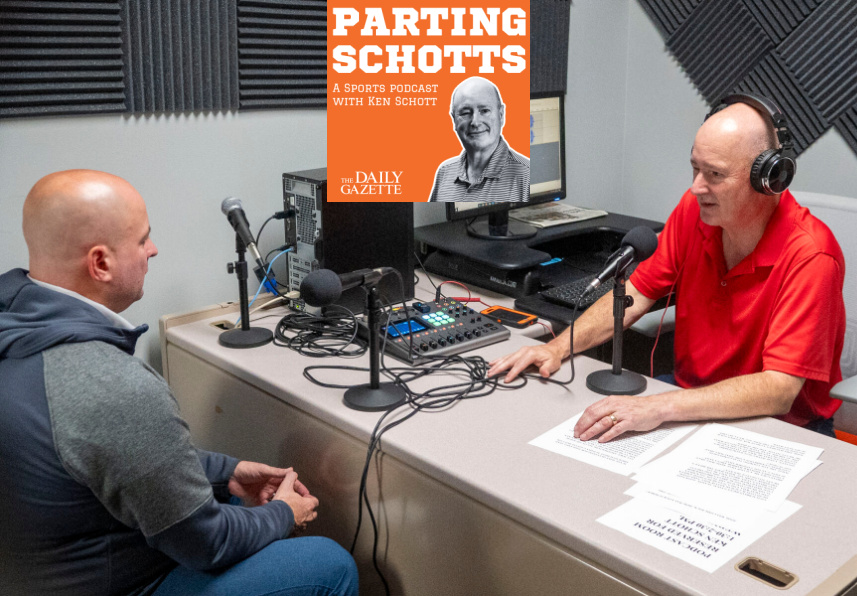
Thank you, Scott Gezy, and welcome to the Parting Shots Podcast, available wherever you get your podcast. Subscribe today. Thanks for joining me from the Parting Shots Podcast studio in Schenectady, New York, for the historic 500th episode of the Parting Shots Podcast.
A standing ovation here at the Party Shots Podcast Studio. Thank you, thank you, thank you one and all.
Oh, yeah, we got here January 15, 2026, the 500 episode of the Parting Shots Podcast. I can't believe we got there.
An amazing run got started with this podcast in 2018. I had been laid off by the Gazette at the end of September 2017. I worked at Channel 6 for a little bit and Mark McGuire, who was the executive sports editor, was resigning. He was leaving. He called me in August and said, you want to come back? And I said, sure. I mean, and the interview was, are you breathing? And I said, yes, and I'm tired. I became the associate sports editor in August 2018, and there was a podcast when I arrived here. It was Hosted by Jake LaHood. He talked a lot with Jim Schultz on high school sports. And Jake was a news reporter and anisky and nave. And he's going to be on a little bit later on here on the podcast. We'll talk about that in just a minute. But when Jake left to go to a job in New Hampshire, I was given a chance to host a podcast and I accept it. And look, here we are now, 500 episodes. It's an amazing run here. I mean, I've enjoyed every minute of it. I've done a lot, like I said, I've done a lot of podcasts. I do right now, two a week during the Union men's hockey season. Josh Hauge, the head coach, comes in every Wednesday. We chat about the team, and that's a very popular segment.
It gets a lot of listens. And of course, I do the regular episode. And I've had some great guests over the years, not only in the sports world, but entertainment. I mean, just recently, Don Brewer of Grand Funk Railroad, I made him laugh hysterically when I introduced him as having one of the great hairstyles. In the 1970s, he had the big Afro drummer for Grand Funk Railroad when they were coming to Rivers Casino to play. Talked to don Barnes of 38 Special Talk to Wayne Brady and Colin Mochrie, both of whose line is It Anyway, back in the I was thinking the early days of the podcast and I was, you know, give it a chance. I mean, I talk some politics and we're going to talk some politics with Jake Lhut a little bit later as well.
It's been a blast. I mean I feel like I'm doing college radio because I did College Radio for four years at York College of Pennsylvania's WVYC.
[00:03:21] Speaker B: Did.
[00:03:23] Speaker C: DJing, news, sports, sports, play by play, learned a lot, was the program director of our AM station, then the FM station and then became general manager in my spring semester of my senior year when my good friend Mike Ondeko would start a full time job, he was still going to school.
He started a full time job at a radio station in York, Pennsylvania. Starview92 Shout out to Mike. I hope you're doing well my friend.
So this is fun. They get to talk sports and interview not just local people interviewed national sports figures. One of my favorite interviews took place in May of 2024 when I talked to Joe Watson, who was a two time Stanley cup champion with the Philadelphia Flyers, a team I grew up watching and attending games at the Spectrum back in the 70s. And I mean Joe was just a blast. I could have talked for him with him for two hours. I had a chance to meet him a little later that year when I went down to visit my mom in Philadelphia and I was just, and I told Joe this and if I ever get a chance to talk to other members of the Philadelphia Flyers of those years, even the Phillies and the Eagles. Reason I'm in this business because I want to be a part of that sports, you know, being talking to athletes and covering games. I've been fortunate.
Started my journalism career in the fall of 1983.
I was at York College of Pennsylvania my junior year and took a journalism class taught by two members of the York Daily Record, Jack Tobias and Gary Dudery. And one of the requirements of that class was to do a one day internship at the paper. And it was my turn. It was shortly after the Baltimore Orioles had beaten my Philadelphia in the 1983 World Series that I got to go down to Kennerdale High School, which is in Southern York county right near the Maryland border. The Orioles were playing a charity basketball game that night and I got to interview a few of the Orioles and went back, wrote the story and the sports editor there at the time, Steve Greenberg, liked it and made a few changes which I was a novice. I was like, I was nervous and wanted to make sure I got everything Right.
Steve says, you want to do some part time stuff? And I said, do I get paid? He said, yeah, okay. And that's how it began.
And I gradually went to full time, covered the HERSHE Bears from 1985 to 1990, got to cover two Calder cup finals and won the win in 1988.
I worked with some great people at the York Daily Record, and one person in particular, and I've had him on a few times on the podcast, is Ken Rosenthal. I saw him get his start in the business and he went on the Curry approach in Camden covering the Philadelphia Flyers and then eventually to Baltimore to cover the Orioles. And now he's a national baseball reporter for Fox Sports and the Athletic. So like I said, great to have him on. I mean, I had John Smoltz on one year. He was playing at charity golf, that celebrity golf tournament, and they set a press release. I figured, why not take a chance? And it was at the time when Ian Anderson was pitching well for the Braves. So it was a good tie in there.
Yeah. So it's been fun. I mean, I do have a lot of people to thank. Gotta thank first of all, Mark McGuire for bringing me back from my 11th month hiatus, as I like to call it. Michael Kelly, who took over as sports editor from Mark, and he gave me a lot of leeway in doing this podcast, basically gave me the free reign on what to do with this. And I appreciate that.
Miles Reed, you know, always enjoyed working with him.
Adam Schinder, who used to work here at the Deli Record, now works at another newspaper. I won't mention the name, but I mean, I've will spring said our current executive sports editor.
It has been a blast. One person I really need to thank you.
The man you hear at the open of this podcast, Scott Geasy, my great friend from our York College, Pennsylvania days. And we worked together in the radio station. They always hung out and had a great time.
Good story. I will tell you about Scott.
My first year of running our AM640 station was the carrier current station, which was what they said basically just heard on campus.
He got me to sing a couple of lyrics from the Beatles song Ticket to Ride. I said, okay, whatever, I'll do it. And next thing I know he's cutting a promo with me singing and saying WVYC AM640 Ken Shots radio station. I cracked up.
Scott was good at that. Another thing Scott was good at, we had a James Bond parody that we did called Double O Nothing. Fred Bunk. He played Fred bunk. I played Mr. Splat. We had once, our second year doing that we call the Wrath of the Trekkies. And I I have to find the tapes that maybe one of these days maybe I'll play a sample and just it was we had a lot of fun doing that and doing different voices and all that fun stuff. That was a great time. But Scott, I appreciate you doing this.
You have, you've always had a great voice and it really sets the tone for this podcast. So thank you again.
So now that we've got a lot of thank yous out of the way, let's preview. It's gonna be an extended version of the podcast. We're gonna have a lot of fun with this one. As we usually do on Thursdays we preview the Union men's and Women's hockey weekend. The men have three games in four days.
They'll host Brown at 7pm Friday at MT Bank center and then Yale will come sit there at 5pm Saturday. After day off Sunday, Eugene travels to Boston to take on Harvard at 4pm on Monday.
That game would have been January 31st as part of the Dartmouth Harvard trip. But Harvard gets ready for the bean pot semifinals on February 2, so they always get that Saturday off before the bean pot. So Harvard also got to play three and four that weekend this weekend. So everybody's in the same boat. So we'll talk to defenseman Nick Young, forward Parker Lindauer and goalie Braden Gillespie about this upcoming weekend for the Garner Chargers.
They're trying to get out of this funk of losing Friday conference games and winning Saturday games in Conference 05 and ECAC Accuplay on Fridays and 411 on Saturday. So we'll talk to them about that.
The women head to the north country to take on St. Lawrence and Clarkson. They're in a rut right now.
Last weekend, their two games against Quinnipiac, Princeton and Quinnipiac, they failed to get 20 shots on the goal again. That's four straight games and they got to find a way to get out of this offensive funk. We'll talk with head coach Tony Macy and defenseman Stephanie Bourque, forwards Joe Willis and Matty Leaney. We'll stay on the hockey theme. The Winter Olympics coming up and Union and RPA will each have a representative playing for the respective countries. Union goalie Monia Wagner will be playing for team Switzerland and RPI's Nina Kristof will be playing for Germany. I'll talk to them about the upcoming experience.
As I mentioned, Jake Lahat, the original podcast host with here and then we'll talk to him about how the origins of that his podcast started and then we'll talk some politics as well. It's a it was enlightening segment with Jake.
I think you'll enjoy it. And then our good friend of the show, Freddie Coleman will be on. We'll talk about a variety of sports topics.
Always love talking to Freddie. Great man. And we always enjoy having him on the podcast. So it's going to be a long one, but a fun one. So let's sit back and relax and enjoy it and let's have some more cheers from the fans. Thank you. Thank you.
Coming up, we're going to talk Union men's and women's hockey. You're listening to the 500th episode of the Parting Shots podcast.
[00:11:49] Speaker D: How can you measure the value of education based athletics? Well, the value is in what makes it invaluable.
That's because school sports aren't just about winning. They're about learning and growing. School sports aren't just about gaining trophies and accolades. They're about learning life lessons, bringing a whole community together, developing character and integrity, having coaches who mentor you and teammates who become lifelong friends. And you can't put a price on any of that. That's what makes education based athletics invaluable.
Of course, when you participate in school sports you want to win and become a better athlete, but the purpose is so much greater. Becoming a better person.
Support your local school sports programs and if you have a student, encourage them to get involved. This message presented by NISFA and the New York State Athletic Administrators Association.
[00:12:55] Speaker C: Welcome Back to the 500th edition of the Parting Shots podcast. I'm your host, Ken Schott. The Union men's hockey team back in action at MT bank center this weekend, their first regular season game since December. Of course, they had the exhibition game two weeks ago against Royal Military College. Union looking to move up in the ECAC hockey standings. Currently in seventh place with 14 points, four points behind Cornell for that fourth and final ECAC hockey tournament. First round by slot. The Garner Chargers have had a really interesting pattern in conference play this season. Friday games have not gone well.05 including last week's 72 loss at Quinnipiac. But the Saturday games have been completely different. Union is 401 that won to tie the shootout win at Colgate.
But they have been unbeaten in conference play, including knocking off Princeton at Hobey Baker Rink. Historically frigid Hobey Baker rink. I should add four two, ending Princeton's six game winning streak overall and their Nine game home winning streak. So measure of revenge for the Garnet chargers, who were manhandled 51 by the Tigers at M&T Bank center on Dec. 5.
We talked with players Nick Young, Parker Lindauer and Brayden Gillespie on Tuesday at the media availability. Just talked about what the team has to do to get off this funk. And you know, they have, like I said, Brown and Yarrow coming in. Two teams that Union should be able to beat. They're down in the standings right now and they need these games to make that run for a first round bye. So let's hear from Nick Young, Parker Lindauer and Brayden Gillespie.
Nick, I'll start with you.
You guys have had a pattern of losing Friday conference games but not losing the Saturday games. What do you got to do to get the wins on Friday and get off to a good start this weekend not being playing catch up?
[00:14:56] Speaker E: Yeah, I mean, I think we're trying to address that right now and just making sure that we're playing with our back against the wall every single game now. I mean, we need to go on a stretch here and try and, you know, climb the ECAC ranking. So I think if we have that feeling of every game's a must win game, then we'll have that Saturday effort every single night.
[00:15:13] Speaker F: Parker, kind of look, like Nick said, it's being addressed in the room right now. Like we're aware of it and what's happened the past few weeks in ECAC play. So we're tackling it together and obviously Friday is going to be a tough, but I think we're gonna be ready to go.
[00:15:33] Speaker C: Yeah. Because Brett, you guys, non conference games on Friday has been pretty good. I mean, so can you bring that non conference mentality?
Basically, I have to bring that non conference mentality to the conference games.
[00:15:43] Speaker E: Yeah, I think we, as they said, we've addressed it in the room and I think we're just ready to get back at it and go again Friday, get the win and just keep on rolling from there.
[00:15:51] Speaker C: Yeah.
[00:15:52] Speaker F: What are some of the things you guys are looking to do differently this time around on Friday to kind of bring that sense of urgency that you guys have had on Saturdays?
[00:15:59] Speaker E: I mean, just come out with the same mentality we do Saturdays. Like every game's a must win right now, so we just need to get these wins going.
[00:16:07] Speaker F: Yeah, I think maybe we put a little too much pressure on ourselves when it comes to ECAC play.
Just knowing that there's points on the line compared to out of conference. Maybe that's why like, we do better out of conference on Friday.
But with that being said, like, every game is important from here on out. Like, each point matters. And if we want to climb the ladder on ECAC standings, we got to start weighing on Fridays.
[00:16:29] Speaker C: Yeah, I think you're only four points out of that last first round by slide. Cornell's got that right now. Cornell's got two games in hand, you guys. So the focus.
How big is that focus to try to catch that, get that fourth spot?
[00:16:42] Speaker E: Yeah, I mean, obviously we're looking for the one spot.
It's never out of the question for us and our group. Like, we know what we have and we've seen it now it's just about putting it together. And I don't think it's a physical part. I just think the mental part of, you know, making sure that every single night we're at our sharpest. That's like the most important thing.
[00:16:59] Speaker C: How big was that win Saturday after Princeton, after what happened at Quinnipiac? Because, you know, you go down there, you're facing the ECAC League team, team ranked in the top 20, and they, you know, they handle you here, five one. So how big was it to, you know, get that win and, you know, level things?
[00:17:17] Speaker E: It was huge. I think, you know, them not losing in their rank, them being number one in the ECAC and going in there and beating them proved something to, you know, us that, you know, it doesn't matter who we're playing, if we play our game, we can, we can take them down. So I think it was huge points and helped us climb a little bit higher.
[00:17:33] Speaker C: Of course, you guys have an interesting schedule here this week. Three games in four days.
You know, Brown Friday here, Yale here on Saturday, and then at Harvard on Monday afternoon.
How's that? How are you going to handle that kind of pro type schedule?
[00:17:46] Speaker E: Yeah, you just handle it one day at a time and one game at a time. I think that, you know, we're just going to handle Brown first. See, you know, prepare, take care of our Friday night issue, which is first at hand, and then just take the rest as it comes. Obviously, playing on a Monday and a three and a four is difficult, but all of us have done it before. And juniors, whether it's, you know, ushl, vc, John, anything like that, but, you know, we've been there before, so we know what you do, Parker.
[00:18:12] Speaker F: Yeah, I mean, I'll just keep it simple. Like one game at a time for us is the mentality, we're gonna start Friday, move to Saturday, and then after both those games, we'll have one day to get dialed back in for Harvard. And I think Sunday we'll be traveling down there. So get there a day early and get some sleep and be ready for the third game, right?
[00:18:31] Speaker E: Yeah. It's just the exact same thing they're saying it's just one game at a time. We just need focus on every game. So it just starts with Brown on Friday, then we go from there.
[00:18:39] Speaker F: When you talk about one game at a time, but you've also mentioned wanting to climb the standings, how important is it for you guys to start stacking some wins together at this point in the year?
[00:18:46] Speaker E: I mean, I think it's very important. We're coming down to the final stretch soon, so I mean every point really matters, especially in these standings. Like every, every win's huge. So I think we just gotta stick together here and keep going.
[00:18:59] Speaker F: Yeah, I mean, you look at like the ECAC standings and no matter if you're on the top or the bottom, any team can beat each other on any given night. And I think you see that in like the US Rankings too. Like our conference is finally getting some attention that we deserve. And I just think that every game is just as important as the last or the first. So no matter where you are in the standings, every game's gotta count.
[00:19:25] Speaker E: Yeah, I think it's important. And you know, like the best teams that do well at the end of the year, the ones that get on a streak towards the end and you know, that's the time right now. So I think it's super important that we start stringing some together.
[00:19:38] Speaker C: The Union women are back in action this weekend on the road at St. Lawrence on Friday and at Clarkson on Saturday. The Garner Chargers have yet to win a road game and their offense is sort of dried up. They were not not getting many shots on goal for the last weekend. They failed to get hit the 20 shots on goal mark. That's the fourth second straight weekend, four straight games that the union has failed to reduce 20 shots on goal and it's really affecting them right now. They're in last place in the ECAC hockey standings and hopes of a first round home game in the ECAC hockey tournament are fading away at this point. They got a lot of catching up to do and they got to find a way to pull off some upsets up in the the north country this weekend.
We first talked with Tony Macy about the circumstances this team is facing.
Tony last weekend. Again, less than 20 shots to go in the games. It's four straight games where the offense has been struggling. What do you got to do to get it going? I know last week you said it was basically part of the defensive effort, but what do you have to do?
[00:20:45] Speaker G: Yeah, I think the biggest thing is we got to continue to compete hard.
You know, when we did have our shot opportunities, there was a difference in our compete level and our effort level, I think.
And I still think it comes from the defensive side of pucks. If we can't defend to where we're making sure that they're not getting opportunities and getting second opportunities, it'll allow us to get to the other end of the ice.
[00:21:07] Speaker C: You have to voice situation like you did against Quinnipac, where you give up 20 or 20 or more shots in a period and you're basically. Does that tire you out trying to defend all that way?
[00:21:18] Speaker G: It does. I think a lot of that came, you know, within a five minute major that we were able to kill off.
So I do think that was. That was a big part of it. And then, you know, just kind of getting back to making sure that we're defending hard and then being able to use our benchmark. I think that's a big thing as well. Like, I think we have to shorten our bench a little bit at times and that can. Can wear on us.
[00:21:45] Speaker C: Yeah.
[00:21:45] Speaker F: Are there any specific adjustments you guys are going to make in the D zone to kind of prevent so many shots on goal and kind of break.
[00:21:52] Speaker C: Out a little more successful?
[00:21:53] Speaker G: Yeah, I think a lot of it's execution and that's. That's on us. Like, that's us again competing in our own end in practice, executing our passes. Like, I think we talked about it afterwards, like, we struggled to connect on two passes coming out of our zone, and if you do that, it's going to be hard to get to the other end. So we got to really focus in on not just the first pass, but multiple passes moving up the ice.
[00:22:15] Speaker C: What about the playoffs? Obviously, home ice might be slipping away for that first round.
I mean, they still have, obviously, games left, but how important is it going up to St. Lawrence and Clarkson this weekend to try to get some points and keep yourself in the hunt for first round home ice?
[00:22:30] Speaker G: Yeah, that's our goal. I think at the end of the day, you know, we'd love to be here. We did. We've had a lot of successes on home ice. Right. So that's. That's definitely a goal, but that's not what our train of thought is right now. Our train of thoughts Got to be one day at a time. So we got to look at it as we're going to take it one day at a time. But when it comes to playoffs, no matter where you're at, you really only have one day, right? That next day, it doesn't matter if you're, you know, at the top of the league or the bottom of the league, you know, or you're getting in the NCAA tournament, you really only have that next game. So we've got to keep that mindset going into playoffs so that we're in the right frame of mind doing that.
[00:23:08] Speaker C: What do you have to do up there? Yeah, obviously the road's been a problem so far this season. What do you have to do to get a win on the road?
[00:23:14] Speaker G: Well, I think we just have to play simple road game and compete again. I think our compete was a little bit better in the QPAC game than it was or the QPAC Princeton weekends than it was the weekend before. Still not to where we all want it, but that's again, something that we are consciously working on. So we're doing stuff in practice to do that as well up our compete there and hopefully it translates. And that's, that's going to be the big thing. I think you're going to St. Lawrence, you know, it's going to be a little bit of chaos, you know, with Wellesley on the bench making it that way, and that's just the style they play. And Matt with his team there, Clarkson, you know, we know they're going to come in and be a hard team to play against because they're going to be physical like they were on us here. So we've got to be ready for that and be ready to push back.
[00:24:02] Speaker C: What do you think about Monya going to the Olympics? How special is that?
[00:24:05] Speaker G: Oh, that's an amazing opportunity for her. She's worked so hard, put in the hours, put in the effort.
She'll be back on the ice here for goalie session here at one o' clock, too. So, you know, super excited for her for the opportunity. It's something that as a kid you dream about wearing your country's jersey and logo, and to be able to represent at the Olympics is just awesome.
[00:24:27] Speaker C: What's the schedule for her? When does she leave and how's the goaltending situation going to happen? What's going to happen with that once she leaves?
[00:24:34] Speaker G: Yeah, it looks like we haven't got exact flight details yet that comes from the Swiss association, but it looks like, like it's going to be Right after Mares cup and then, you know, I trust both our goaltenders that are, all of our goaltenders that are here. So just a matter of sorting some things out. And I know they're going to be competing for that spot sometimes to be ready to play in those games that we have when she's gone.
[00:25:01] Speaker C: So basically the Mare's cup game will be Mona's last for the season with Union.
[00:25:05] Speaker G: Way to schedule it potentially for the regular season for sure.
Right. Obviously, if we can make a run in playoffs or at least get by that first weekend and get into the series stuff, then maybe we'll be able to have her back coach for this team.
[00:25:21] Speaker F: Just this weekend going forward, does there become a little bit more of a sense of urgency after kind of the slow start to conference play that you guys have had?
[00:25:30] Speaker G: I think there's some of that for sure. I think we. When you think about sense of urgency and all that, I think they can get a little bit lost in the pressure of it. Right. And then with that comes a little bit of negativity on yourself. Not to say that we have negativity. It's just a matter of having the confidence moving forward to play in these higher profile games. Again, we're playing teams that are in the top 15 pretty much every weekend. So for us it's just making sure our compete and our effort are up.
[00:26:06] Speaker C: We also had a chance to talk to three of the Union women's players. So here are Stephanie Bourque, the team captain and defenseman, and forwards Jill Willis and Matty Leaney.
Guys, last weekend again didn't get over 20 shots on goal. It's four straight games without getting 20 shots on goal. What do you got to do to get the offense going?
[00:26:28] Speaker H: Yeah, I think it goes back to our defensive zone. I thought the past weekend our compete was a lot better and we didn't spend as much time watching the other team. So I think it's just going, building off of that and keeping that, trying to squash things faster in our D zone. And I think if we do that, then the ozone will come for sure.
[00:26:45] Speaker C: Joe?
[00:26:46] Speaker I: Yeah, I agree with Steph. We worked really hard last week on our D zone and D zone transitions off to offensive zone and that's how we're going to get shots.
[00:26:54] Speaker C: Maddie?
[00:26:54] Speaker I: Yeah, I agree with both what they said.
Our offense kind of comes to us pretty good and so I think just keeping our movement going and really sticking to our structure is going to be a big thing for us.
[00:27:04] Speaker C: Has been frustrating. Stephanie, with all the struggles of the offensive Lakers. I mean, there's plenty of talent on this team. Yeah.
[00:27:10] Speaker H: I mean, obviously it's frustrating. It's not fun to spend like more half the game in your D zone. That's not what you want to do. But it's with hockey. Hockey's lots of ups and downs and it's part of the learning process. It's not just gonna happen overnight. And we have a lot of confidence in our dressing room and we know how to play hockey. So it's just sticking, really sticking with our system. I think that's when we play really well, is when we keep things simple and the offense will come.
[00:27:33] Speaker C: Yeah.
[00:27:34] Speaker F: At this point in the year, do you guys start feeling a little bit of a sense of urgency to kind of get a little bit momentum at this point?
[00:27:40] Speaker H: I mean, maybe a little bit, but not that much. We're still building towards playoff and it's just going to be one day at a time. Everyone makes playoffs. So luckily we have that and we just fight for one more day and that's how we're going to play and that's how we're going to start playing. So most likely they're always going to be like one goal game. So I think it's just going back to our D zone and making sure that that's really good and then the ozone will come.
[00:28:02] Speaker C: Matty, you guys hit the road again. It's been a tough season on the road. You haven't won there yet. What do you got to do up at St. Lawrence and Clarkson to get get a road win or two?
[00:28:11] Speaker I: Yeah, I think it comes with prepping for for it this week.
Even though we haven't had success on the road yet, I think we all have that in our minds and we're ready to make the next step and that's just coming prepared and sticking with our game plan.
[00:28:22] Speaker C: Stephanie?
[00:28:23] Speaker H: Yeah, I mean, it's just going back to what we know and really trusting the process and trusting our systems and I think just not passing up any shot opportunities. Sometimes we might be able to catch the goalies off guard from like off angle shots and just playing hard and crashing the net. I think a of lot of goals are going to come with dirty goals. I think that's how we've had success in the past. So I think it's just going back to that.
[00:28:44] Speaker C: Joe?
[00:28:44] Speaker I: Yeah, I think SLU Clarkson was a big matchup for us last time, so just keeping that up again. This time I think we will handle them pretty well.
[00:28:52] Speaker C: What do you think of Monya going to The Olympics.
[00:28:55] Speaker H: I mean, I think it's awesome. There's no one more deserving. She worked her butt off and I think we're all super excited for her. It's a once in a lifetime opportunity and that was her dream. So I think it's, it's crazy to think that she's achieving her dreams and I know we're all super proud and we're all going to support her.
[00:29:10] Speaker C: Maddie?
[00:29:10] Speaker I: Yeah, I mean, she left our pre game to go get a phone call and came back and we all started jumping and a few of us shed a couple tears for her. She's a great teammate on and off the ice. She supports us no matter what and she's kept us in a lot of games, so we're super proud of her and super excited to watch her.
[00:29:25] Speaker C: Jill, your thoughts?
[00:29:26] Speaker I: Yeah. We love Manya, so I think that we're all super happy for her and probably. And she's worked so hard for this and we all came together as a team for her, so we're super excited that she gets to do that.
[00:29:37] Speaker C: Staying on the Capital Region women's college hockey front, a pair of area players will be participating in the Winter Olympics next month in Italy. Union junior goaltender Monya Wagner will be playing for Team Switzerland.
She's been playing in some international competition with Team Switzerland, including the Lytle Games back in in November.
Wagner has played in 15 games for the Garner Chargers. He has a 4, 8 and 3 record with a 3 point goals against average and a 915 save percentage and a pair of shutouts. The Team Switzerland is going to be in a tough bracket. They are in the same bracket in Group A along with the United States, Canada, Finland and Croatia.
On Wednesday, I had a chance to talk with Wagner about the excitement she's feeling as she heads to Italy.
Amelia, first of all, congratulations on making the Olympic team for Switzerland.
When you got the news, what was your first reaction?
[00:30:45] Speaker I: I didn't really know how to react. Obviously, like a lot of joy and proud moment. I think I just wanted to like scream out loud internally and externally.
And then once I hung up with my coach, I called my parents right away and my sister.
Make sure to let them know because they've been part of the process all the way.
And then we had Team Lyft during that time. So I went right back to the team and then told them, which is.
[00:31:18] Speaker C: I mean, I mean, you've been playing some international games for Switzerland. Did you. I mean, was there any indication that they gave you that you were going to be on this team or is this. Was it sort of, like, nervous, just waiting for that call?
[00:31:36] Speaker I: They never told me that I was going to be part of the Olympic team at any of the camps.
But I feel like me getting to go to the December camp was, like, not an indication, but, like, it was like, kind of like, okay, yeah, I'm really close to it because they brought their two starters and then me as a goaltender, so I was up there goaltender.
But it wasn't for sure at all until I got that call. So I was waiting for it, and I kind of knew, like, I had a feeling that it was going to be.
[00:32:08] Speaker A: Be good.
[00:32:08] Speaker I: But, like, you obviously never know, so there's a lot of nervousness and, like, anxiety and excitement.
[00:32:13] Speaker C: I mean, this is. When you were growing up in Switzerland, was this something that you dreamed of one day that this would happen?
[00:32:21] Speaker I: Yeah, no, for sure.
Like, basically ever since I started playing hockey or since I was a.
A little girl, I'd say I used to, like, tell my parents, oh, once I make the Olympics, you have to come watch me or my best friends.
And it's always been, like, there, and especially once you get through the stages of UA teams.
So, yeah, it was always a goal, and it's really, really fun that I.
[00:32:51] Speaker C: Can'T achieve that now, of course, with women's hockey, we always hear about the United States and Canada. I mean, they're the top two teams in the world. In women's hockey, what is it going to take to, I mean, knock off one of those teams and maybe get a medal?
[00:33:11] Speaker I: We know as, like, the year as Switzerland? I'd say that we're still a lot of steps behind USA and Canada. So, like, every time we play them, it's just about keeping up for them and playing with them as good as we can with their physicality, their speed.
We obviously have good goaltending that can keep us in games.
And then, like, it's obviously really hard to get one of those, like, gold or silver medals, but that bronze medal is for sure part of our goal.
And we'll see, like, we perform well against the Czech and the Finns, even Sweden, in those tournaments that we had. We all are very close together, so we have a good chance, I'd say, of.
[00:33:54] Speaker C: Yeah.
[00:33:54] Speaker I: Competing for that bronze game.
[00:33:56] Speaker C: How have you seen me?
How much has the women's game grown over in Europe? I mean, if you watch for what U.S. and Canada have done, I mean, how much has the sport grown over there?
[00:34:10] Speaker I: I think a lot, especially.
I mean, I can only speak for myself, But I left five years ago, so in 2021 and when I left home it was still like the only professional women's league at home.
Wasn't even really professional. Like 14 years old, 14 year old girls would start playing there and you would have to pay to play for certain leagues or for most of them, especially for women's hockey. And now it's a completely different story. Like a lot of the pro men's team has women's teams and they support each other and then we actually get or they get some sort of a salary. Not anything near like the PWHL, but it's like you can work, I'd say like 50% and then play 50% hockey. And if you're international, you can play, be a full time hockey player. So that's really exciting to see in Switzerland. And then obviously Sweden has a great league, which is one of the best.
[00:35:15] Speaker C: I mean, obviously you're excited about that. But how tough will it be to leave Union? I think your last game will probably be the Mares cup game. I mean, how tough will it be to leave this late in the season while you guys are battling for postseason position and the home ice, at least in the first round of the ECAC hockey tournament?
[00:35:35] Speaker I: It's for sure a tough time to leave and I would love to keep supporting the team and keep chasing that playoff spot. But I also know that Emma and Emily both will get their chances and they're both good goaltenders and I know they'll do great and they'll step up and help the team out. Especially Emma last week and she did great.
So I'm not really worried about that goaltending position of doing a good job there. Them too. But I would obviously love to be around the team and like keep pushing and hopefully getting that past that first round of playoffs and then keep going and towards that championship if possible.
So it's a tough time to leave.
[00:36:23] Speaker C: Do you think your team is rooting for you? But when like you guys play, I haven't looked at some schedule, but if you play US or Canada maybe will your teammates be rooting against you at that point?
[00:36:37] Speaker I: I don't know. I feel like being able to say, I know someone on that team might be biasing you a little bit. So I hope they would, they would root a little bit for Switzerland or for both countries. I can't, I can't make them root for Switzerland, but I'd say they root for me and for Team usa.
[00:36:55] Speaker C: What's it going to be like to walk in the opening ceremonies.
[00:37:01] Speaker I: I don't feel like I'll actually realize what I'm part of until I get there and be part of that. So I'm really excited to get to experience being amongst all those insane athletes. And I don't even know. I'm just really excited. And it'll be probably one of a kind of a moment, like, really special.
[00:37:26] Speaker C: When do you leave for Italy?
[00:37:30] Speaker I: I fly Wilmot, like the day after Mayors cup. And then we have like two or three days after, and I think we'll be in Milan on February 2.
[00:37:40] Speaker C: Any concerns about the ice situation? I think I've heard the women's rink is okay as opposed to the men's rink.
[00:37:49] Speaker I: Yeah, I don't know. Like, we haven't really seen any of the facilities.
Our team managers have been there and they said it should, like, it looks like it's fine.
I've heard there's a lot more, but I mean, nothing that we can influence or change. So we'll have to adapt to whatever we'll get once we get there. And, yeah, I'm sure we can do that.
[00:38:13] Speaker C: Amonia, thank you for doing this. Congratulations again. And we'll be watching on the NBC Networks and see how you guys do.
[00:38:21] Speaker I: Thank you.
[00:38:24] Speaker C: The other Capital Region women's college hockey player headed to Italy is RPI's Nina Kristoff. She's the team captain of the Engineers. This season, she'll be playing for Germany over there in Italy. She's been a fixture for Germany on the international stage. She's competed in four IIHF Women's World Championships and previously captained the German squad that won the 2020 IIHF U18 Women's World Championship, Division 1, Group A.
She has worn the sea for Germany in the 2021 and 2022 Senior IIHF Women's World Cup Championships. She has four goals in 17 games this season for the Engineers. So let's hear from Nina Kristof, who I spoke with on Tuesday.
Well, first of all, Nina, congratulations on being named to the German Women's hockey o.
How big of a thrill is this?
[00:39:21] Speaker A: It was incredible. I think it's every little girl's dream that plays hockey to one day play on the biggest stage that we have.
So it's been a dream come true.
[00:39:30] Speaker C: I mean, you've had some international experience here, you know, Women's World Championships, the U18 Women's World Championships. I mean, how big is it to play on the international stage?
[00:39:43] Speaker A: I think it's always an honor, like, just being able to represent your own country and just how, like, I think in the past years, women's sports has taken a lot of strides of, like, the professionality behind it. And you just always feel it at tournaments like that, how well it's organized. Like, I mean, I was looking at our, like, staff list, and we have, like, 15 staff members traveling to Milan with us for, like, 23 players, which is, like, crazy if you think about it.
So I think that's also really cool. I was just being treated more and more like a professional.
[00:40:11] Speaker C: When you got the news, what was your reaction?
[00:40:16] Speaker A: I was just, like, very thankful and grateful, and I was actually at my grandma's house for Christmas because they called us on the 22nd, and then I told my grandma, and she cried a little and a lot of, like, thankfulness.
[00:40:29] Speaker C: So you knew back around Christmas, and RPI just announced getting ready. I mean, obviously you start to focus on the gains with rpi. I mean, is that a bit of a distraction right now as you. As you look ahead to the. The Olympics?
[00:40:46] Speaker A: No, I don't think so. I think especially because you're like, sorry, cars coming by.
[00:40:51] Speaker C: That's okay.
[00:40:52] Speaker A: I think especially because you're, like, preparing for the same thing. So, like, I don't think I do a lot differently now being a part of the Olympics. Like, we adjusted my. My lift schedule a little bit. I worked with our athletic trainer just to make sure I was, like, at peak performance when I leave. But other than that, like, you're still trying to have, like, Pete's peak skill and, like, peak on ice.
Yeah. Performance.
So there's not much different.
[00:41:18] Speaker C: Obviously. You know, when we talk women's hockey, it's mainly the US And Canada. They always seem to be battling for the gold medal.
What's the goal for the German team? What do you guys want to duke? I mean, obviously you want to win a gold medal, but how important is it to get at least get to the medal round?
[00:41:37] Speaker A: Yeah, I think for us, like, we usually always make it into the quarterfinals, and then I don't know if you know how, like, the tournament is laid out. It's basically the first five, like, one through five are in group A, and then six through ten are group B. So for us, it's really important to finish first of our group for group baby, so that we don't have to cross over against Canada. Usa because they usually finish first or second.
And that kind of just gives us the best chance at, like, going against Czechia or Switzerland, someone who's still like, very good team, but more.
More beatable than USA or Canada. So get into the quarterfinals in a good position, and then go on to the semis.
[00:42:20] Speaker C: How has women's hockey grown not just in North America, but in Europe? Obviously, as I said, you know, we always hear about USA and Canada, but we really don't hear too much about the European teams.
[00:42:33] Speaker A: Yeah, I think the German federation, like the German Hockey Federation, has done a great job of promoting the women's game.
And like, for example, for our Olympic qualifier, we were able to host it last November, and we ended up, like, selling out with like 3,000 fans. Like, obviously a smaller arena, but still just a great side for women's hockey. And then even a tournament that we played this past December, we also, like, sold out with, I think, two and a half thousand fans.
So I think the main message is that if you advertise it, people will come.
You just have to make sure you advertise it and get out there.
[00:43:12] Speaker C: There's been talk about the ice surface and the construction. Is there any concern on your part with the.
The venue there at all?
[00:43:21] Speaker A: No. So they actually already told us that our venue is ready. The venue that is not ready is for the guys tournament because we're gonna play in two separate rinks.
[00:43:28] Speaker C: Okay.
[00:43:29] Speaker A: Because getting 20 teams in one rink, it's just a very tall task.
Yeah. So it's actually split up to two rings, and our rink is already ready and we've gotten some footage of it, so it's very exciting and thankful that we don't fall under that same.
[00:43:45] Speaker C: I mean, your last game for RPI will be the Mare's cup game on January 24th.
I mean, I know you got games this weekend at Clarkson and St. Lawrence to worry about, but how much? Looking forward to that Mayor's cup game next Saturday.
[00:44:01] Speaker A: Yeah, like, it's. It's gonna be awesome. A lot of our alumni are coming back.
It was just. It feels like a great bang to go out with.
And playing against Union is always a grind, like rivalry. It's gonna be a good game. So just excited to go out with the bang.
[00:44:17] Speaker C: Well, Nina, appreciate a few minutes. Congratulations again and good luck there in Italy.
Coming up, we'll talk with Jake Lahat, who hosted the first Gazette sports podcast. He was a news writer here back in the day. And we'll talk about his other job, which is covering politics and the President of the United States. You're listening to the 500th episode of the Parting Shots podcast.
[00:44:55] Speaker H: Speed, skill, physicality.
Home to college hockey's elite teams, coaches and student athletes.
ECAC hockey. Twelve programs competing at the the highest Level.
A league where champions are born and.
[00:45:09] Speaker B: World class professionals are trained.
[00:45:12] Speaker H: Where history is abundant and a commitment to the cutting edge is unrivaled. The best facilities, the fiercest competition.
ECAC hockey. There's no experience like it.
[00:45:43] Speaker C: Welcome back to the podcast. And that music was the original theme, the open and close of the podcast, which started way before I began here. And the man who started the podcast is in the podcast studio here. He's at the to be in town. He was a reporter for the Daily Gazette for many years. Now he's covering Donald Trump.
It's Jake Lhut. Jake, welcome back to Schenectady and on your own home in Niskuna. And I'm honored to have you in here because you were the first person, even though you were a news reporter, you were doing a sports podcast here at Daily Gazette.
[00:46:18] Speaker D: Yeah, well, thanks for having me in. This studio setup is impeccable.
I'm not sure really why they let me do it, but I basically pitched my former boss, your boss, Miles Reed, on the idea of sort of meeting some demand for high school sports. And I was like, hey, what if we did just kind of a roundup of all this great coverage we had from folks like Jim Schultz, Michael Kelly, and we are always meeting these deadlines for sports coverage, but a lot of people were listening to pot. This is around, what, 2018, listen to stuff in their car. And we thought, like, hey, why not just like, let you know, really? My initial inspiration was hearing Jim Schultz when I would work on a night shift or something. He'd come in the office and he'd just give me kind of the straight summary of whatever game.
[00:47:06] Speaker B: Jim.
[00:47:06] Speaker C: Jim would always do that.
[00:47:07] Speaker D: And he just knew so many incredible details about the student athletes that I figured, like, okay, I mean, you see how impactful sports can be, you know, in terms of like your high school team, your youth sports team, you end up in the paper, you get it framed. But also just this, you know, that's like 500 tight words from Jim Schultz. Right. Where he knows all these other incredible details about their background, about how the season's gone. And so, you know, I just turn the mic over to him and let him rip. You know, bring. And then bring in whoever else.
[00:47:34] Speaker C: Yeah, because I know I was laid off my last day here. My first go around was September 30th of 2017. So I was working at CBS 6 as a.
I forgot the morning.
[00:47:48] Speaker D: It was like a silent producer.
[00:47:49] Speaker C: Thank you. Yes, thank you.
And then, and then when Mark McGuire was resigned or leaving As a sports editor, Mike Kelly took over. And next thing I knew, they. I got a call from McGuire and said, do you want to come back? I said, yeah. And then the interview process is. My question to you is, are you breathing? And I go, yes, and you're hired. That was basically. So, I mean, I came back. Yeah, I came back and you were doing this and I was coming back. You know, I had covered Union hockey for 25 years and got reassigned. And then my, you know, spent that 201617 season on the sidelines and really just basically was just doing copy editing and laying out the section. And I came back here in associate sports, and I knew what my role was going to be, so I was like, I had no worries. I mean, I'll admit, you know, working Channel 6 was not fun. I mean, I know some. Some great people are there, but you're there at 7:00 in the morning, you don't get out of there. Almost six o'. Clock. And it's like, I have a lot of admiration for what those guys do in television. It's not. You just don't show up and do a report.
And not being a news guy, it was tough, and I admit that.
But it was a good experience. I learned a lot. And of course, I never knew I would end up leading to be a sports center now sports desk editor here. But when you left, I think I was asked if I wanted to take over the podcast. And I thought, yeah, why not? Because, I mean, I did college radio. I was on Roger Wyland's show for many years doing the college hockey talk.
So, I mean, I was comfortable with it, and I just had to figure out the direction I wanted to go. I mean, did I just want to do high schools? And so I expanded, and after the COVID year, I got union hockey back, and that really expanded my portfolio as far as, you know. Now during the college hockey season, Josh Howsey, the head coach, he's in his fourth year. We're in our third year of doing a weekly podcast together, so. And that's been a lot of fun being able to do that. So that's a great time to cover union. Yeah. Oh, yeah. They're playing well. New arena and all that fun stuff, and. But I know even though you were a news guy, you were a big sports guy. I know you're a Red Wings fan, and I've seen you in pictures with the Quebec Nordiques jersey.
Did you ever want to be a sports writer or sports broadcaster?
[00:50:11] Speaker D: That's a great question, because I Think I got to actually do a little bit of it in New Hampshire. So I said where I left the Gazette for was this newspaper, the Keene Sentinel. And I was basically just going there to position myself to, you know, want to get further into political journalism by just kind of waiting for the New Hampshire primary to come around in the 2020 presidential election. So I got to cover, so hockey for Keen High School. Who haven't. They made, like, a big state championship run, and they were a really good team.
And it was just a numbers thing that we had basically two sports editors who also wrote all the copy and did all the photos and put all the pages together. And, you know, this is just kind of the state of.
Of local journalism by, you know, by 2018, 2019. And then one of them got a job with Nessen, you know, the original.
[00:50:59] Speaker C: New England Sports Network.
[00:51:00] Speaker D: Yeah, yeah. And then so the down to one guy. And so I started filling in a little bit of that. Like, I covered the. The New Hampshire State track and field championships without arriving, without knowing the rules or even who I was really looking for.
And it was really fun. And I loved, especially in writing about hockey, just like, the immediate impact it would have on, you know, the kids and the families. And I think, you know, because I had played, I like to have some fun and be very specific about what I was describing in terms of, you know, the gameplay, what kind of stick handle maneuver happened before a goal. So, you know, for the first time in a while, a term like toe drag would appear in the paper. I think the kids and the coaches were really excited about little details like that. But, you know, I mean, I watched a lot of SportsCenter, like a lot of kids, you know, my best friends, that was kind of the. The little boy, you know, background track was just having sports center on, you know, in a morning or on a weekend or whatever.
But I think that I've always tried to borrow certain elements from sports reporting. And also there are people who end up in political journalism who have a background in sports reporting, and I think that they do share a lot of qualities. I mean, people always deride the horse race coverage kind of thing. But there are a lot of other principles that I think hold up.
And a lot of sports reporting also just has the fundamentals of beat reporting. But, yeah, it is one of those things where this wasn't totally intentional about my career, even though, I mean, I always was very into politics as a kid and just, you know, wanted to cover that. I think there's also this thing where my Career has gone, you know, around the time I was getting into this stuff in 2017, 2018, leaving college, you know, just the demand for reporting around, you know, the first Trump term, you know, the subsequent elections, all that stuff. It was kind of in its own way a kind of mini goal golden era, you know, of political journalism. And that just kind of brought me to a lot of weird places. But you know, I think if you had asked me as a little kid playing for the Chargers or whatever, you know, up the road from here, I don't think I did not think I was going to make the NHL. I did always want to play college hockey.
And you know, if you had run by sports reporting as a topic, I probably would have been pretty partial to it.
[00:53:15] Speaker C: Yeah, I mean, how much fun was the playing for Schenectady? Because I know my son played for it for many years and he enjoyed it.
[00:53:21] Speaker D: So I think the real, it was always really fun.
I played there pretty much my entire youth hockey career, I think starting in like squirts. I played at Troy Albany before and the, the best part for me and a lot of guys I came up with was the final three years. So basically all middle school legendary union players Joel Beal and Glenn Sanders became my coaches starting like first year peewees. And of course, you know, I, my folks were season ticket holders to union growing up. So I had seen Beal and Sanders, you know, in their prime, knew about, you know, Joel's points record.
I was personally a huge Glenn Sanders fan.
And then, I mean, even going into my sophomore year of high school when I was playing Albany Academy, Glenny still coached a, you know, one of those before and after teams I was on. So he was still opening the defensive bench doors for me and stuff. All those, you know, going a long way.
I think that the thing that maybe, you know, if there are like, you know, kids or parents of young athletes listening to this, there's something about the rivalries that you develop around here and they're largely the same teams. You know, Clifton park still got a team, Saratoga, Glens Falls, the Albany Capitals I think are the only one that didn't really make it, you know, from, from my era of playing.
And you know, you develop these interesting relationships with guys in your, you know, guys and girls in your age group in those other organizations. And it was interesting when I got to Albany Academy, like a couple of my, you know, former rivals are suddenly my teammates especially there was this guy, Corey Cummings, who played for Saratoga. Great, great player. And he had kind of that like I don't know what you call it, like. Like a Tom Wilson or, like, you know, very skilled forward, but also through the body around kind of an agitator for them. And I was in sort of an enforcer role as, you know, the biggest guy on our team. So, you know, we were duking it out for years, and I, like, basically hated this guy. And then we became good friends at Albany Academy and just, I think, you know, you want to cherish that time you have with your age cohort because once everyone's moving on into high school hockey or you might have kids, you know, on those teams whose high school doesn't have a program. And I think, you know, just really enjoying all the time spent with those people is huge. And, you know, Beal and Sanders were just great coaches. I mean, we went from being.
I mean, this actually perception kind of carried over at once. I was at Albany Academy, but, you know, the Schenectady was kind of known as, like, the, you know, easiest opponents at that time.
I loved our swag. Before the color change to the union, you know, garnet and white. We wore oranges kind of. Well, not just that. These, like, if you look up the old Nashville Predators jerseys, yeah, they basically were orange, orange and black, but they also had this, like, silver shining stuff on the. The whole length of the arm. And, I mean, I really miss wearing those things. But be on. Sanders took us from, you know, really, like, having a hard time every season.
I don't talk about wins and losses. I'm just talking about some, you know, getting occasionally humiliated by. By teams around here or anyone who is that good in the immediate, you know, area to suddenly, like, work. We're, you know, winning the presectional tournament, you know, outright competing for, you know, a state championship. And it was just that specific experience of, you know, seeing these guys come in with a vision and a plan and being able to improve alongside these great friends I grew up with, and then being able to, you know, start beating a lot of these teams, and there's just nothing like it. You know, I'm gonna start just going on and on about the glory years.
Shut me down, Ken.
[00:56:50] Speaker C: Well, I mean, I'll ask you about. You're a big Detroit Red Wings fan. It's been a while since they've been in the playoffs. Of course, they knocked off my flyers in 1997, four straight. Well, three years old, won't talk about that.
But, I mean, they're playing well right now. I mean, is this a team that finally has found its identity and Maybe can make the playoffs.
[00:57:08] Speaker D: So, you know, I read a lot about the ISER plan and I, I think the big shift for me as a Red Wings fan, I noticed in terms of the team actually being better is that I read a lot less coverage of prospects in the draft now where that used to be like the only real solace, like, oh, we're gonna have a high dream this year. Wonder who it's going to be.
I mean, I thought the big thing for that, for that team with this young core we've had, you know, it used to be, you know, Dylan Larkin, Tyler Bertuzzi, Anthony Mantha, now, you know, Larkin still there, but we have the younger core of defenseman like Morit Cider, Lucas Raymond, Marco Casper, all these great prospects who have been coming through. It felt like the defense was just missing your solid like, you know, number three, number four, maybe number five, number six, defenseman.
And I think that a great example of just the, I don't want to call it a complete turnaround because Eisenhower's been plugging away at this for a long time. But this young kid, Axel Sandin Pelika, who I think he wears number 44 for the wings, incredible young defenseman. You know, we'll play on the, on the bottom pair or the second pair, but is, you know, on the power play and the fact that we got great goalies in the pipeline, I mean, I'm hoping we make the playoffs this year. But we also got, you know, the Sebastian Kosa kid in Grand Rapids, Troy Augustin at Michigan State, my mom's alma mater. So shout out Spartans nation there and you know, I'm very optimistic watching them play, but everything is so stacked up in the NHL this year that, you know, I think we, I mean right now we're duking it out with the Carolina Hurricanes. I believe there's a back to back match up on the night of this recording, but you know, you could have a little skid and suddenly we're back where we always are. So it is hard to have hope.
[00:58:48] Speaker C: Yeah.
Being a Flyers fan, I know that feeling because it's been. They're getting there. But yeah, still they still need a couple of pieces.
Let me ask, I mean I should have asked you this before, but are you working on your own right now as a freelancer?
[00:59:04] Speaker D: Yeah. So, you know, I am in talks with some publications about, you know, full time jobs and can't really, you know, a ton more about that. But it's feel very lucky to be there. But yeah, I've got a. I think by the time this comes out, this piece might already be out. But I have a story with New York magazine that'll be coming out soon. I've been working on for the past couple months that I'm very excited about, about a politician. I've covered a lot in my years and I'll just let the story reveal that person and then, you know, I just do a little bit of writing on the side on a sub stack newsletter called Straight from the Hut. And this is basically a publication where, you know, when I'm, if I got a freelance piece, I'll link to it there. If I got some, you know, side observations or some interesting stuff that might not be a traditional story, I'll write it. And it's only going to accept, you know, paid subscriptions for a short term basis, you know, so you can consider like a one time donation.
[00:59:57] Speaker C: Straight from the Hut sounds like it would be a title of a Weird Al Yar Yankovic song for a straight Bryan Adams Straight from the heart. Yeah, yeah.
[01:00:05] Speaker D: But you know, the idea is that kind of that more direct relationship where you know, you can speak your, your mind a little bit as a reporter, pull people behind the scenes a little bit.
And you know, also I think just for people who may be really sick of getting just really having to be on social media at all for their news, I do like the option of being able to just distribute my stuff directly via email so that I'm not depending on, you know, an algorithm or something to feature my link or not.
[01:00:33] Speaker C: And you've made some appearances on Ms. Now, which used to be msnbc. So you get to hang out with Chris Jensen who the former Chris Capistachi who's working on actually.
[01:00:42] Speaker D: Unfortunately this got cut from the clip that was put online. So only people with like who happen to be DVR on the show would have it. But we had a whole shout out to the Capital Region thing when I was on her show for the first time. And she's great.
She still is in touch with Benita Zahn, she told me, and is extremely, extremely knowledgeable after her years, you know, covering this area for wnyt. So that's very cool. And you know, you do find Upstaters, you know, all throughout national journalism and the cable networks. Buffalo I will say does really punch above its weight and has a very big presence. Probably the biggest I think of anyone outside of New York City.
[01:01:17] Speaker C: Of course, Carrie Lake replaced Chris Janssen at News Channel 13 and that did not work out after. And look what she's become.
[01:01:26] Speaker D: I know, I know I know some people who have worked for Carly Lake.
[01:01:30] Speaker C: Yeah.
I gotta ask you, I mean, let her in. How haven't you lost your hair or your hair turned gray covering the orange menace that's in the White House?
[01:01:41] Speaker B: Yeah.
[01:01:41] Speaker D: I mean, so I think that actually covering this stuff is a productive outlet sometimes for some of the more absurd or ridiculous things that can happen.
But, you know, I mean, I think the real reason I've kind of stayed in it and stayed focused is, you know, I really love this country.
I believe in the power of journalism. And I think that there's kind of been something in my cohort of, like, millennial Gen Z Cusper folks. You know, if you're born in, like, the mid to late 90s, you know, that kind of timeframe when we were coming through either going to college or coming through college is when the golden escalator ride happened. And Trump started running when I was a junior, he won. When I was a senior at Wesleyan in Connecticut, and kind of comparable to the Watergate era, there was this, you know, statistical boom of journalism majors. And my school didn't have journalism as a major, but I was editor in chief of my college paper. Also ran a little political review where he had students write, like, their best attempt. I don't know, like a white paper policy argument or something.
And, you know, I think that what I was seeing as I was coming through high school and early college, you know, was that sort of first wave of how smartphones were really affecting the way we consume information.
And, you know, I just think being on this beat as long as I have been, which, you know, I mean, I've been working as a professionally for 10 years, but I'd say for a solid last four or five, I've really been on the Trump world beat, especially from covering the 2024 campaign.
If you're not gonna do it, someone else will. But also I think that you have a degree of control over what topics you want to raise salience on. Being able to talk to everyday people is great. And I think, to answer your question about not losing your sanity, I think a big part of it is that unlike the way life tends to go in America these days, we're depending on where you're living or where you worked, where you went to school. We're all in pretty siloed lives, and those get really hardened online with just how Your Facebooks and YouTubes and TikToks of the world have delivered stuff to us with an algorithm. And you don't talk to a lot of people. You might disagree with. Whereas in this kind of a job, I get to talk to people who have all sorts of political beliefs all the time.
You know, I've had some insane conversations with regular voters or people who are, you know, often it's like, I've always tried to have a balance between, if you're on the road, finding people who are not actually the self selected crowd who goes to a political event versus people who are at a grocery store out and about. And, you know, for the one like, totally insane person, you're like, wow, this person sounds like they want to like start a civil war or something.
You run into like, you know, 10, 15 who actually have some really interesting, often contradictory opinions.
And I think I can say now, especially covering Congress and people who get into campaigns, I mean, there's all sorts of bad grifting, corruption, ulterior motives, all that stuff is very present in this space. But also when you meet people who go on the staffer level in both parties, people tend to go into this for the right reasons. And there's often a really interesting origin story for why they do it. There's. But you know, I also think that just on a final note, on the Trump side of it, you know, like, I've talked to a lot of older reporters who lived in a certain world before Trump came down that escalator. And then there's been a world since then. I think you look at Covid as another dividing line. And I think that a lot of these journalists served our country really well.
And it kind of became time to pass the baton in a certain way. And I feel a bit of an obligation, you know, for the people I grew up with and my family to, you know, to make him proud and just put as much as I can into this coverage as long as I can.
[01:05:49] Speaker C: Yeah, I'm 62 and I remember I was old enough to watch the Watergate hearings back in 73, 74.
And I've always heard the story. It was Republicans, Barry Goldwater and Hugh Scott, and Goldwater from Arizona was Hugh Scott from my home state of Pennsylvania.
When they saw what was going on with the tapes and all that, the Watergate tapes, and they went to Nixon, said, you don't have our support. And they were Republicans. And Nixon knew at that point it was time to resign. Why aren't there Republicans with that kind of backbone now with Trump, with the way he's acting, with what he's done in Venezuela, he's threatening to take over Greenland and he's been threatening Canada.
We're becoming that kind of country that we don't want to be like in fascist Germany in World War II and Italy. And why are we, why wasn't there somebody out there that would stand up to him and say, you're wrong? I mean, all of a sudden, Marjorie Taylor Greene is the voice of reason after all these years, what's going on?
[01:06:54] Speaker D: So, I mean, putting aside the fact that I've had a lot of private conversations with, you know, lawmakers, people who work for them, where, you know, you hear, like what you hear people say on TV all the time, I'm like, they, you know, they, they are quite afraid of Trump. They don't think this is good.
Putting all that aside for a second, it's a very short answer to your question, which is basically Fox News. And I think that if Fox News and the kind of conservative media ecosystem had existed in the way it does now when Watergate happened, I don't think Nixon would have ever resigned, and I don't think that congressional support would have gotten that bad. Now, I do think that we're in new territory here in terms of some Republican resistance to Trump. And I think a lot of this honestly just really depends on some basic math where pretty much this entire time, you know, since Trump got into office the first go round, he has been more popular than almost all the House Republicans are in their own districts. And this is usually the same for, for a Republican senator from a red state that whoever Trump endorses in the primary will likely do very well and win or at least it'll drastically change that race. And a lot of the, you know, I define the base of any party as simply the people who decide to vote in primaries. You know, that's been the laws of physics for the early part of this. But I think starting with the Epstein stuff over the summer, you know, you've really seen that other people are making calculations in the medium to long term that, you know, he is a lame duck president and they want to have some semblance of a future in politics after this. But, you know, like, no one's going to come and stop this. I mean, I think that's something other people just got like a very, very real talk. People should understand, you know, if you're watching what's happening in Minneapolis effectively being occupied by, you know, ICE and border patrol agents, like the courts have often on a delay. And that's the nature of the way the system works. They have intervened and stopped the Trump administration from doing a whole host of things. But there's A lag time to that. And also at a fundamental level on the foreign policy front, there's nobody who's gonna be coming to stop this thing. And I think it sounds probably maddening to hear, but people have to stay extremely engaged, I think, for kind of you and your family and your friends own well being, stay reasonably vigilant in terms of looking out for the news. And unfortunately, nowadays you have to put in a lot of extra effort to find, I think, good, credible reporters, information outlets and things that are not just aggregated and all that stuff. But the fact of the matter is the Republican Party really is Trump's party. It's in his image. It's going to be that way, I think, for a little while.
But no one's going to quite have the same broad cross appeal that he brought in terms of his mix of the type of celebrity he was, the way that, you know, a lot of what worked best for him in that first primary was simply torching other Republicans in the establishment. And now he's become that establishment. And I think that we're going to see someone, whether Marjorie runs in, in 2028 or someone else who's going to challenge JD Vance, there's going to be someone who's going to make a play for that core base again who have become very disaffected in a lot of ways with what's happened to me.
[01:10:11] Speaker C: This ice situation, it's 21st century Gestapo.
[01:10:15] Speaker D: I mean, yeah, it's hard to try to.
[01:10:22] Speaker C: Renee Goode gets shot in the face. We see it and they're trying to twist it like, oh, she's a domestic terrorist. That's B.S. we know that. I mean, and people at the Department.
[01:10:29] Speaker D: Of Justice are resigning over being told to prosecutor.
[01:10:32] Speaker C: Yeah, yeah.
[01:10:33] Speaker D: Or investigate her at the very least.
[01:10:34] Speaker C: It's, it's. I mean, I mean, I mean, is, is Trump leading us toward a civil war in this country or even worse?
[01:10:44] Speaker D: I wrote this was a, this was a really interesting, tough period when I was at Wired, had this newsletter, Inner Loop, that was about, you know, basically Trump world and Silicon Valley billionaires and kind of how they, you know, interact with.
And we did a special edition sometime in the aftermath of the Charlie Kirk assassination.
And this has been kind of the first wave of Trump trying to send the National Guard in other states and really honing in on this concept of what actually are we dealing with when it comes to military personnel doing law enforcement activities. So I talked to a ton of historians, you know, or as many as I could find in this kind of weirdly small universe of civil conflict historians who are not just civil U.S. civil War historians.
And look, they think that the term Civil war is not adequate for what we're dealing with and what we may be heading toward. One of the reasons is that, you know, you can't just go up against the US military and try to win. I mean, in terms of the notion that like in our past civil war, there were territories, there was a separatist government, and there were two, you know, competing militaries that didn't have an air force, you know, I mean, had naval capabilities, but not remotely what US military is today. Right. And then the question is like, you.
[01:12:11] Speaker C: Know.
[01:12:13] Speaker D: Governors have access to National Guards and should they deploy them in their own cities to stand off with the federal government and then what happens if someone fires a shot? And like, you know, I think every governor so far who especially, you know, Pritzker in Illinois, now Governor Walz in Minnesota, Governor Newsom in California, you know, they were much more, I think, searing in their rhetoric than governors typically have been in the smaller versions of these disputes we've had with the federal government. But they also made sure to not really put their own National Guard troops anywhere where there could be a standoff with ice. So instead, you know, when I talk to these historians for that piece, the thing I was really struck by is I think a more comparable situation in some respects to what we're going through would be the early stages of the troubles in Northern Ireland, where there is kind of a neighbor on neighbor element to this.
A lot of the British troops who did a lot of the violence and the crackdowns during the troubles were 18, 19 year old kids from Liverpool and Manchester. Often they grew up in essentially Irish Catholic households. And they're going to a city they'd never been in before. They're not trained for this and they're extremely scared. And I think that that's on the worst case scenario end of things. That's where it really is pretty scary is like, how bad could it get if we see more things like the shooting of Renee Goode in Minnesota and there have been other ICE involved, instances where people have died, gotten very injured, but it hasn't resulted in this kind of full blown popping off. So you're really looking at kind of almost like a cold Civil War type scenario where there really hasn't been like there's not an organ. Even though the Trump administration has talked big game about antifa being the supposedly organized crime scene hit, the fact of the matter is that there really isn't an organized rebellion in the US and honestly, I think that a lot of people who have been in the streets protesting, while they're very mad, and they will let their thoughts be known on the ICE officers, and they will try to use a critical mass of people to get them to go away.
No one is trying to light stuff on fire, cause chaos. Because I think after people live through the summer of 2020, and they saw how Trump responded to that, there's this weird, unspoken awareness that the administration seems to be trying to provoke something like we saw after George Floyd's death.
And this is where my sources in Trump world have been kind of uneasy, is that they.
They know that this isn't popular or a good look.
They largely agree with the aims of Stephen Miller, that they want to have these mass deportations. But also they know that the way this is playing out is a complete mess and is a huge liability for them.
But like I said earlier, I think wherever we go from here, the big question is, other than our elected officials in Congress, there's really nobody who can do much intervening here.
But I think that is important to keep in mind that all that being said, this administration has shown several times that they do respond to public pressure.
I mean, it's wild that there were stories before ICE was sent in these numbers to Minneapolis that the Trump administration, because of these court orders and stuff, had largely given up on trying to do these military occupations of the streets. I think that the Minnesota welfare fraud scandal kind of gave them what they thought was a semblance of a reason to go in there. And you'll hear Christy Noem talking about how they're investigating the fraud and all that.
[01:16:07] Speaker C: Don't wanna start.
[01:16:08] Speaker D: But, yeah, you know, I think it's something that people should really think about is just like, you know, the fact that this is not. It's not like whenever it would happen or whatever that is of some sort of civil conflict. It's not gonna be like you get a formal bulletin that, like, this has started and there are lines of troops shooting against each other. I think instead, when you look to history and places outside the United States, it's a much slower descent into it.
And I think the question is just in terms of scale, how bad could that get?
[01:16:41] Speaker C: What about World War iii? Are we on the verge of that with Wade? I mean, he's. The NATO allies are going to defend Greenland if Trump invades.
[01:16:51] Speaker B: Yeah.
[01:16:51] Speaker D: I mean, if you read the news coverage in Europe, it's really striking how they've been worried this whole time. But it was largely around us hanging Ukraine out to dry. And the fact that the realization of, oh, we are now going to have to fully defend ourselves against whatever further Russian aggression might come, the Greenland stuff was not taken seriously. And actually I was at my first ever Trump rally that I covered in New Hampshire was when he tweeted that he wanted to take over and, you know, buy Greenland. And we're all the reporters and other people in the Concords were all looking around, what is going on here? The last like 10 days or so. And really since Stephen Miller's wife, Katie Miller, tweeted out this image of, you know, the map of Greenland covered in an American flag and, you know, the rhetoric from, from Trump and Rubio and Hegseth starts to reach a certain point.
Folks in Europe are now, yeah, they're fully thinking about what kind of credible.
I'm not sure if you want to call it a threat or a way to dissuade the United States, but militarily, what could they do to convince Trump that you absolutely cannot seize Greenland? Aside from what they've already said reminding the US Government that we can put as many troops as we want in Greenland totally legally?
I think on the broader World War three question, I think, look, there are people I've talked to have kind of two ways of looking at this.
One is that what Trump did with Maduro and Venezuela is could hearken back this old school spheres of influence type way that the world operates where instead of us kind of enforcing some degree of international order along with the UN and everyone trying to protect, they care about international law. And whether they follow or not, it's a different story. But that instead of that system, we would have essentially us doing whatever we want in the Western Hemisphere. Let China do whatever they want in the South China Sea with respect to Taiwan. Let Russia do whatever they want in Europe.
I think a really important conversation that needs to be had and there's good reporting happening on this, but it doesn't get a lot of attention. Is also in the continent of Africa with USAID effectively no longer existing.
And the way Russia has used their Wagner mercenary force down there and what France is trying to do to counteract it, that is also a whole scenario where there's this vacuum we've created and that could have a lot of pretty horrific consequences. And then the very brief second school thought is that instead of that spheres of influence thing, the whole reason Trump's looking at a purchase of Greenland is or a straight up holding of territory in Greenland in the Arctic Circle is because there would be some sort of broader global conflict where Russia and China would be allied.
And you simply want to, not just for drilling or other reasons, have that Arctic territory, but have it as a literal buffer for actual transatlantic warfare. And I think that, you know, there's not enough evidence, I think, to fully bolster that second one yet. But, you know, people who have these conversations for a living and, you know, have actual security clearances have talked about both of those with me.
[01:20:11] Speaker C: How much was the Epstein files bungled?
Hugely.
[01:20:15] Speaker D: I mean, look like, you know, the Trump folks really do largely blame Pam Bondi, even though obviously, like the fact that he ran on it and all this other stuff that, you know, everyone, everyone knows at this point, it's like a real reason why. But, you know, they, I mean, to give you like the inside Trump world, you know, what the people who are actually able to counsel him on this in the White House will say is we should never have given these conservative influencers these fake binders with stuff that was already out there, open up this can of worms promising people like a final resolution to this whole thing.
But yeah, you know, the other thing that I think people who even, like, they have every inclination to wanna pull for Trump, but insist that they think this has all just kinda gotten blown out of proportion. And other than being maybe pals with a guy, he never really did anything that wrong, they still don't really have an answer for why are they behaving like they're so guilty.
And the frustration always comes back to they are doing things that make them look more and more guilty and erode the trust of the public even more. And it's clearly a before and after thing. I mean, I think there are a lot of people where it's not. They're like single issue Epstein voters. I don't think you or I has ever met one. But I mean, a lot of people of a lot of ages and a lot of backgrounds I've met who were really invested in this. And the whole Epstein saga really does, aside from its very specifically horrific characteristics. It also has this element of people who don't tend to believe in conspiracy theories, like, well, this just doesn't add up. And this is very weird. And yeah, I mean, I think that it's a live by the die, live by the sword, die by the sword thing, where when you prime your audience and your voters to think there is this secret knowledge and there are these conspiracies everywhere, it's really hard to tell them to turn that faucet off and just believe you on face value.
[01:22:00] Speaker C: Final question.
Trump's health, both physically and mentally, is.
[01:22:04] Speaker D: Going for the heavy hitters here.
[01:22:07] Speaker C: I mean, his physician claims he's in the best health, but, well, he doesn't look good. And you got to wonder about his mental capacity.
[01:22:18] Speaker D: Look, I mean, look, going back to the first term, I think there were hyperbolic claims about Trump's mental decline, and I think there were more sound points made about it. And what I have heard from people who are around the Trump campaign in 2020 was that he's always been very concerned about dementia because of his father, Fred Trump Sr.
And I think that Trump is someone who wants to actually know, and he wants to do the screenings, and he keeps bragging about doing these cognitive tests over and over again. And I think that part of the way of understanding that is like, you know, it is kind of relatable on a human level where there's a family history here and he is obsessed with, you know, wanting to have a completely clean slate of health on it. The IV stuff on the hand, I have no idea what's going on there. What I can tell you is that I was not the only reporter to notice that last January in the transition, there were photos of Trump walking around with Elon Musk, where he had the bandage and bruising on the top of his hand. And the Trump campaign, sorry, the Trump transition was not commenting on this back then, but they did have someone do a background comment to the New York Post with the same exact excuse that it was the handshaking and the slapping on the back of the hand or whatever. And I don't believe that at all. With eyes and ears wouldn't, however, look. I mean, the bar is now so high for his public appearances in terms of the frequency of them. I mean, Biden, I think for reporters who are paying attention, you knew when Biden was having kind of a B plus day or a C minus day. I called it B12. Joe hadn't taken his supplements or not, and that was my joke.
Other reporters on the beat at the time, but Trump has just primed people to see him all the time. And there was that period where he wasn't making any public appearances for a whole long weekend, and people thought he died or something.
So that's gonna be tricky because they can try the concealer. They can try to have him sit during as many events as they want.
They can try to curtail his domestic travel. But look, as I think Biden showed, even if you're a really Middle aged, healthy president. These international trips can kick the crap out of you.
And I think that I would keep an eye on those basic things as how much is he traveling? He's done a lot of international travel this year, but not a lot of domestic travel. And then what are the nature of his appearances? Is he gonna be in a rally type environment again? They've tried to restart that and it hasn't really gone great. So look, I think that ultimately he clearly is with it enough to be talking on camera and be doing these things. But also like, yeah, I mean these, these, these flubs are very real. They're a very real thing that the White House doesn't like the coverage of. And I think that just by virtue of some of these little things like him sitting during the duration of an event in the Oval, they're plainly making concessions to his, you know, and we've seen him.
[01:25:11] Speaker C: Yeah, we've seen him too. Also, you know, recent video. I'm limping until he saw the cameras on him. Then he started walking like he was. Nothing was wrong.
[01:25:18] Speaker D: But he's always been so conscious of that stuff. And that's, I think, unfortunately the particularly torturing aspect of this for him is like, not only did he call Joe Biden Sleepy Joe and ran on Biden, you know, being, you know, past his prime and essentially senile and all that stuff, but like he is a president who has delegated significant authority to someone like Stephen Miller and is really just kind of doing the fun parts about being president. I mean, I had a source one time describe Miller as the. They call him the prime minister internally.
[01:25:47] Speaker C: I call him something else.
[01:25:48] Speaker D: And that Trump, you know, has really this, at the second time around, wanted to do all the fun pomp and circumstance stuff, but it's like you only have so much fun with the pomp and circumstance as you're physically able to do. So, you know, I think people should just don't read too much into the speculation about like what the specific ailment is.
I think this will, it'll, it'll come out, you know, in time, but just like use your eyes and ears and see, you know, what exactly is he able to do on camera now that he couldn't to a year or two years ago?
[01:26:14] Speaker C: Yeah. Well, Jake, thank you for starting this podcast back in 2018. It's been a blast to take it over and coming on in the 500 episodes. It was great. It worked out that you're in town and to be able to sit here face to face, talk sports, talk politics. I mean, it's been a blast. I appreciate you coming in and good luck and please give Chris Jansing our best for real.
[01:26:38] Speaker D: Thanks for your strength stewardship of this show. And you know, it's no small feat making it to, to have a thousand years.
[01:26:42] Speaker C: Yeah, well, if I, if I get the thousand in a few years, well, I'll be in a wheelchair probably at that point.
[01:26:46] Speaker D: But Ken's cognitive.
[01:26:49] Speaker C: Yeah, well, when you talk to Chris again, ask her how about her Cleveland Browns. All right, watch her. Watch out. I can see her face like. Oh, good.
[01:26:58] Speaker D: No, especially in the middle of a very serious segment.
[01:27:01] Speaker C: Yeah, you're talking about trouble a Chris, about those Cleveland brands.
Jake again, thanks a lot. Appreciate it. All right, that's Jake lot.
Coming up, Freddy Coleman of ESPN Radio, one of our favorite guests will join me to come on the 500th edition of the Parting Shots podcast.
I wanna make this.
The Daily Gazette has some great subscription deals happening. Sign up today at www.dailygazette.com. and as always, when credibility matters, trust the Daily Gazette.
Welcome Back to the 500th episode of the Parting Shots we podcast. So one of my favorite guests on these podcasts has been the man who hosts Freddie and Harry on ESPN radio from 3 to 7pm it's our good friend and my good friend Freddie Coleman. Brother, how are you? Happy New Year. How are things going?
[01:28:43] Speaker B: Everything is Good. How about 500 your podcast? I'm honored to be your guest for the fire on your one, my man.
[01:28:48] Speaker C: Well, I appreciate you doing this and I've always enjoyed having you on and you very always able to make time for me. I have appreciated that and it's great to have you on. And how many episodes have shows have you done? Espn? I mean, have you lost count?
[01:29:04] Speaker B: Oh, I never counted when I first got started there when I was auditioning canon. I can tell it's probably in the thousands of the broadcasts I've done between doing Game Night back in the day and doing the Freddie Coleman show and then doing stuff with Ian Fitzsimmons and now with Harry Douglas and doing the NFL and ESPN radio for three years and college football shows with Noel Kuiper Jr. And everything like that. So, yeah, I'm sure that that number is a number that is completely, completely unattainable for me to figure out exactly how many times I've had a chance to be part of ESPN Radio.
[01:29:34] Speaker C: What would you tell an aspiring podcast or broadcaster?
What would you say to them if they want to break into this business?
[01:29:43] Speaker B: The one thing I'll tell anybody is make sure you put your product and yourself out on as many platforms as possible. Don't say, well, I don't want to put it there. Enough people are not going to see it. You don't know who is out there paying attention and watching and listening and learning from what you're able to put there. So as many platforms you can put your product and yourself out there, you should definitely not say one platform is more important than the other because all platforms are important to make sure you can be seen or heard and definitely have a chance for people to experience what you're doing. And one thing I always tell young podcasters, even older podcasters as well, don't worry about being the second or third somebody else. Be that first you, whatever that first you is. Because so many podcasters or even young people in our business, they see people have been able to make it to a certain level, they think they have to be like that. Well, those people got to that level because they were being authentically themselves. They weren't trying to be somebody else. And you don't want people looking you and say, oh, you remind me of somebody. Then they don't know where you begin and that other person is. So always think about being the first. You don't worry about being the second somebody else.
[01:30:43] Speaker C: That's great advice, Freddie. I hope everybody listens to that. Well, let's talk some sports here.
News that broke overnight Thursday morning.
Looks like the New York Giants and John Harbaugh are going to get together and Harbaugh is going to be the new head coach of the New York Giants. Is that, is this a good move for the Giants and Harbaugh?
[01:31:01] Speaker B: Well, consider the coaches that they've had as Tom Coughlin that did not work out, whether it was Joe Judge, Pat Shermer, Brian Dabel, Ben McAdoo, as I called him, Ben McAdon, the years that he was in charge of the New York Giants. And if you're the New York Giants for the first time in a long time, you have respectability and accountability when it comes to the new head coach, when it comes to John Harbaugh, no matter how things ended this past season involving the Baltimore Ravens and even Steve Bashade, somebody asked him, what if that field goal was made by the Baltimore Ravens against the Pittsburgh Steelers and they win the AFC north, would that have allowed John hard to keep his job? He said, yeah, for one week, even he was ready to move on from John Harbaugh. So you're the New York Giants. You know that anybody that he brings with him to coaching your New York Giants is going to make your team better. It's gonna, it's gonna be almost impossible to think that this is not gonna be an approved football team because that's the kind of football coach that John Harbaugh has been for the Baltimore Ravens. And I don't think take it that long for him to get this turned around and going in the direction that the Giants have sorely missed and have been lacking since Tom Coughlin retired.
[01:32:02] Speaker C: Of course, me being an Eagles fan, I've enjoyed the Giants miseries over the last few years. But the big question for me is how is Joan Shane still the general manager of this team?
[01:32:14] Speaker B: Because he was able to go out there and get John Harbaugh and the fact that John Harbaugh wants, wants to work with him. That is something that's a feather in the cap of Joe Shane. And let's keep it 100. Joe Shane, he's been able to draft pretty well and be. Get some quality free agents for the New York Giants. I just think they made the wrong choice as it turned out. Brian Dabel, sometimes you're better as a lieutenant and not as a chief. I thought Brian Dabel was more of a lieutenant than being a chief and that proved out when it came to New York Giants. Even though they made the playoffs with Daniel Jones as their quarterback. I think Joe Shane, his track record of finding talent and having somebody needed to develop that talent, I think that's where John Harbaugh comes in. So if Joe Shane was enough for a general manager, the kind of talent that they've been able to assemble, even though we have not seen the results on the football field, I don't think John Harbaugh takes this job or if he takes the job, then he wants to bring his own guy in. He wants to work with Joe Shane because he looked at Joe Shane and said, boy, he's been able to get that kind of talent. Now we need somebody to put that all together. And that's where John Harbaugh comes in.
[01:33:11] Speaker C: And they have a pretty decent quarterback in Jackson Dart. If he voids, you know, you know, being, being a little more careful when he runs with the football and stays healthy, I mean they, they could be a team to be reckoned with down the road.
[01:33:23] Speaker B: Yeah, well, think about this. Brian Dable might have been able to keep his job had the Giants really keep fourth quarter leads, but he let it go versus Chic. They let it go versus Denver. They let it go versus the Dallas Cowboys. I also don't think that Brian Dabel helped himself by keeping by and sawing Russell Wilson starting quarterback when nobody rallied around him. But that was more of an organizational decision above his head. I think if he had his way, he just started Jackson Dart earlier, least Jameis Winston earlier and not have Russell Wilson out there. But that's in the past. John Harbaugh is walking to a situation where he has not only a quality future star quarterback in Jackson Dart, but a quality backup. And James Winston, a veteran who's been around. You got pieces on that offensive line that played really well for the New York Giants all season long. And now Cam Scatterberg coming back from injury, he's ahead of schedule. Malik Davis coming back from injury, he's ahead of schedule. So now you need someone that will have the coaches that can raise that talent level and put these pieces together. John Harbaugh is a perfect fit. He wanted the job, the job wanted him. And that was exactly what's going to happen going forward.
[01:34:22] Speaker C: Well, let's talk about the team, the other team that occupies MetLife Stadium, the new York Jets. And my God, what a disaster. We thought it couldn't get worse for the Jets. It did. How does a team go through a 17 game schedule and not have an interception?
[01:34:39] Speaker B: I don't know.
That's along the lines. And not getting a rebound in the NBA game, if you play an upfront position, you should think at some certain point you'd have fallen into an interception. But other than that, with the New York jets, the one thing that's really something that they can really rise up and say, we got this. Players never quit on Aaron Glenn. Players never quit on each other. And yeah, that could not have been easy where you don't have an interception as a team. The quarterback situation was in flux. The defense was up and down, more down than up. Aaron Glenn, Yeah, you have to hope that he learned from some of the coaching decisions that he made that turn out to be mistakes that tend to be bad results. But no matter what, people can say how bad the season was and it was indescribably bad. As Tim Cookson likes to say about certain things in Major League Baseball, Ken, they never quit on their coach. They never quit on each other. They always stood up and fought for each other. So now if you the New York jets, you have that culture in place that guys will fight for each other and fight for their coach. Now I need to go out there and get a talented guy at the quarterback position. Now I need to make sure that Gary Wilson has a Robin to his Batman at wide receiver. The defense wasn't bad. I just think they played too many snaps and he got a quality running back in Bree Hall. So there are elements there. But the one element they don't have to worry about other than making sure they find a way to get some interceptions next year is will they fight for each other and fight for their head coach.
That was proven in year one and now you got to trampoline off of that and get some wins and get some confidence and get some quality players to make sure that year two does not look like year one.
[01:36:06] Speaker C: I know you're a Dallas Cowboys fan. They had a great offense this year with Dak Prescott.
Their defense was atrocious. They had gave up the most points. I mean the jets were second worst defense, the Cowboys were the worst. I mean give up over 500 points in the season. Just truly amazing what what happened down there. Why doesn't did Jerry Jones fire their general manager?
[01:36:27] Speaker B: Well, number one, that's not happening because Jerry Jones not going to look himself in the mirror and say I am the problem. And I never thought they should have hired Matt Eberflu to begin with. I don't know what they saw to say this is a guy that should run out defense, but not as if. He was a great defensive coordinator with the Indianapolis Colts and we saw exactly how TR the Chicago Bears defense was under his watch and under his tutelage. I don't know why Jerry Jones thought that that would be a good idea to hire that guy as a defensive coordinator, especially when you move on from M. Parsons and Maddie. Ma always had the excuse, well, I don't have a pass rusher and I got guys engine on defense. Hey, you're a defensive coordinator. Bring the damn thing out. If you're mad Eber fools. And you always seem to hang on more unexcuses than anything else. So now you bring in a guy that has to know defense and there are going to be enough guys out there that can do that with that kind of personnel. This way you don't look like that and you don't have your quarterback believing he's in Arena Football League games, which was time and time again what happened with the Dallas Cowboys football team. So Jerry Jones is not going to fire Jerry Jones as the general manager. He even said earlier this week that you're going to deprive this team out of his cold dead hands. He's really going to be in it to win it no matter what. But whatever or whoever he decides as defensive coordinator he's got to solicit other people in the organization because he may think he knows football. I know he knows what a football looks like. That doesn't mean he knows football, running an organization properly and determine the right hires when it comes to coordinators or assistant coaches on his football team.
[01:37:50] Speaker C: Of course, the trade in the preseason didn't help matters either.
[01:37:55] Speaker B: Well, we knew from your mouth to God's ears as far as that goes, Ken, because when you decide to get your nose crossed with one of the best defensive players, if not the best defensive player not named, Miles Garrett, International Football League, that's when your ego gets you into trouble. And how many times have we seen Jerry Jones's ego write a check that his old behind cannot cash? And that's happened time and time again. This is what happens when he is determined to prove that he knows football enough to be a championship owner. He's sick and tired of people saying the reason you had those championships before was because Jimmie Johnson and Jimmy Johnson's players. Well, it's okay to admit that because what a great leader supposed to do is find the right kind of people to lead your organization. And he ran two guys out of there that were great leaders, Jimmy Johnson for one, and Bill Parcells for the other, because the ego got in the way. So as long as his ego is going to be as big as Jerry Jones in the state of Texas, the Cowboys are going to be what they are. They'll have a playoff team once in a while, but do you trust them to have a deep playoff run? As long as Jerry Jones is the. And his ego gets out of control, stays out of control. I can't see another championship with the Dallas Cowboys with Jerry Jones being the owner of this football team.
[01:39:01] Speaker C: Yeah. To me, Jones thinking that. I think he's trying to relive what happened with the Herschel Walker trade when he traded Michael Parsons. You get all. You got all these draft picks and that turned out to great because, you know, they got, yeah, Emmett Smith, Michael Irvin, all that. But the packers are not a team that's, you know, it's in their standings. They're not going to. The picks are not going to be great. So. So I think maybe he's just living in the past.
[01:39:25] Speaker B: Well, here's the difference with that, though, in terms of when it comes to picks, Jerry Jones doesn't make picks. Will McClain, that scouting department. Don't miss on guys. Look at the guys that Dallas Cowboys had drafted that wind up hitting for this football team, whether first round, second round, whatever round that is. Will McClay is one of the great talent evaluators in the National Football League. That's the one place that Jerry Jones has stayed out of the way. It's that the Dallas Cowboys, in terms of not so much making trades, but finding players in free agency or undrafted free agents that become really great players for the Dallas Cowboys. So those pieces are going to be there. Will ML is the one that drafted Dak Prescott in the fourth round, drafted Duron Bland in the fifth round out of Fresno State. He was the guy that brought a lot of these pieces together. Where Jerry Jones said, okay, I can leave that alone because he knows what he's doing. As long as that continues and Wil McClain that's got in department keep continue to find those players, they should be fine. I think they got the right guy in Brian Scheideheimer that can be a good head coach. You saw he did with the offense, how they developed that offense and one of the scarier offenses in the National Football League. They need to get the defensive coordinator right because they're not devoid of pieces. And they can get more pieces in the draft as long as Jerry Jones stays out of that mix because Jimmy Johnson was the one that orchestrated that trade version Walker. And look how many guys that they hit on because of that trade. They have a potential chance to do that again because wilmaclay in that scouting department is really, really good with the Dallas Cowboys.
[01:40:46] Speaker C: Let me ask you, we had major coaching news on Tuesday. A day after the Pittsburgh Steelers lost to the Houston Texans 36 in the AFC wild card. After 19 seasons, Mike Tomlin steps down as the Steelers head coach.
First of all, his legacy, I mean, he never had a losing season, won a Super bowl, but the last seven playoff games the Steelers appeared in, they lost them all. Which tied Marvin Lewis, the Bengals coach, for most consecutive of playoff losses.
How would you describe Tomlin's legacy at Pittsburgh?
[01:41:18] Speaker B: His legacy should not even be questioned. And I know it didn't look right and didn't feel right and didn't have results that were right those last seven playoff games. But I seem to remember that when the Pittsburgh Steelers hired him, that that was a questionable hire according to people. And then two years in, that's a great hire by the Pittsburgh Steelers. 193 wins in the regular the season. 201 wins overall as a head coach. 9th all time in the history of the National Football League. And they won a Super bowl championship and got to another Super Bowl. I know Pittsburgh Steelers fans wanted somebody Else. Well, now be careful what you wish for because who you may get may not turn out to be what you have for 19 years of Mike Tomlin. You're right. Ken never had a losing season. You never want to be in the middle. I completely understand the frustration of Pittsburgh Steelers fans, but the whole fire Tomlin, fire Tomlin nonsense, all right, you got what you wanted it. Now be careful that you got what you wish for. It may not turn the way. Exactly. We may be, and I hope we're not having this conversation, whoever the next head coach deals is going to be, I hope he does extremely well. But if it's not looking right, there gonna be plenty of fans are going to look back and say, hey, maybe we were wrong to say they should have fired Mike Tomlin. And I think Mike Tomlin looked at that and said, okay, I've done all I can here. This is going to be a rebuilding team. I'm a little older for that. I don't want to be a part of that. If I'm going to be a rebuilding guy, I want to have a chance to rebuild maybe my own way somewhere else and look at that landscape. So I clearly understood why he decided to make that kind of move. Sometimes just need something else to invigate you. He'll have a chance to do that in tv, take the time off and then the next situation, I'll be there to be the right kind of head coach. That's what he's going to do.
[01:42:48] Speaker C: In this era where coaches get fired after two years or even three years, it's remarkable what the Pittsburgh Steelers have done since 1969, just three head coaches, how remarkable is that?
Especially in the days where social media and the so called experts out there, one coach is fired and. But to see just a team with just three coaches since 1969, just a remarkable feat.
[01:43:15] Speaker B: Yep. It's attributed to the Rooney organization that they were able to have patience with their coaches because many people wondered if Chuck Knowles the right guy early on or they wondered if Bill Cowell was the right guy early on. The fact that they were able to stay of course with their guys and believe in their coaching staffs shows you exactly how remarkable that has been, that kind of run when it comes to the Pittsburgh Steelers. But I don't think we're ever going to see that again because these are modern times that are happening right now in sports and five or six years could be a long time for somebody to be someplace if it's not going the way that you believe it should be. Going, we see plenty of ownership groups don't have that kind of patience. Not saying the steals are going to completely flip that script around, but the days I think of having a guy being around for 18, 19 years like John Harbaugh in Baltimore and Mike Thomas problem with the Pittsburgh Steelers, Andy Reid's been with the Kansas City 13 years. I don't know we're going to see that in a modern era in terms of owners that if they believe that something is not going the way they want it to go, that they may move on a lot sooner than ever before. Materials can continue to be that way with successful head coach I wonder. I can't wait to see exactly who they hire. That's going to be the case. The future never knows. It's not telling right now. But the fact that we see that kind of success, sustained success with three charges, 1969 is completely, completely a miracle. How the Steel's been able to make.
[01:44:30] Speaker C: That work now that my Philoff Eagles were mercifully eliminated from the NFL playoffs thanks to a bad offensive coordinator who finally got his lost his. Sorry, speaking as a fan here, of course, but how wide open are these NFL playoffs? I mean, just we see Denver Broncos, the top seed, the Seattle Seahawks like came out of nowhere the top seed in the nfc.
I mean, to quote, to paraphrase Jim Morrison, the Doors, his song the End, the NFC west is the best. So. But how wide open are these playoffs?
[01:45:04] Speaker B: Oh, I knew for a fact even early on, I say about like maybe week two or three, I said, man, oh man, I have no idea who's going to win in the National Football League. And that's exactly what the NFL wants. That's exactly what the NFL has gotten. Because you look at the top seeds like you mentioned, when it comes to Seattle, when it comes to the Denver Broncos, as good as both of those teams have been so far this year, there are no guarantees that the Denver Broncos, even though the Buffalo Bills are compromising wide receiver department, are going to beat them or that the Seattle Seahawks, with a compromise San Francisco 49ers team, that they're going to beat them. Because both of those teams are really well coached. With Sean McDermott on one side with the Buffalo Bills and of course Kyle Shanahan the other side for the San Francisco 49ers, you can make a case for any one of the final eight teams and say, yeah, if they do this, they can not only get to a Super bowl, but win a Super Bowl. And when you don't have like great, great teams but teams that may be great or aspiring to be great, it's going to lead to compelling football. We saw that part of wild card weekend this past weekend, and I think, and I know for a fact, and this is just me spitballing, that we're going to see that once again, no matter what kind of season Seattle had on one side of the NFC or the Denver Broncos had on the other side in the afc.
[01:46:11] Speaker C: Coming up on Monday in Miami Gardens, Florida, it's the College Football Playoff national championship game between Miami and Indiana. And Indiana University is now a football school. Who would have thought that?
[01:46:23] Speaker B: Yeah, when did Indiana become a football school and Alabama become a basketball school? It's completely madness what's going on in college athletics. For Kurt Signetti, he had a plan in place and he said this is the kind of plan that we need to have that's going to be make things work here in Indiana. Now, nobody expected that he would only have two losses total in the first two years he's been Indiana head coach, but his ability to find players either in the transfer portal or even when he recruits those players from junior colleges and also from. From the high schools has been tremendous. He's getting guys and has made that work. To a team where they look and feel like a typical Big Ten team with a lot of speed and a lot of ability, but they're so well coached, they don't make a lot of mistakes. Mistakes at all. Ken, you play that team, you're going to have to beat Indiana. They're not going to beat themselves. And you can say the case about Miami that at times, with their talent, they have gotten in their way. Well, this is the one game where that cannot happen. If you're out of Miami Hurricanes, if you make those kind of mistakes against a football team that's coached like that, it's going to be a long afternoon on your home field when you try to win a national championship.
[01:47:23] Speaker C: Yeah, we saw what Indiana did against Oregon, that pick six to open the game and just went downhill from there for. For Oregon, who do you like? Is Indiana going to win its first national championship?
[01:47:35] Speaker B: I think they are, but it's not going to be as easy as we saw in the first couple of games what they did to Oregon and how they're able to have that. I don't think that's going to be the case when they beat Oregon twice like they did the regular season and they were able to do that last Friday. Miami's defense is really, really good. They're going to make Indiana who loves to run the football. Miami is really good at stopping the run. Ask Ole Miss about that, what they're able to do to them. Ask Georgia about that, what they're able to do to them. So those are the kind of things that can really work for you in your favor if you're Miami, how you're able to stop those kind of running games like you did versus Texas A and M and what you're able to do last week. But Carson Beck is the key here. If he plays like we saw down the stretch versus Ole Miss, then he's going to threaten that Indiana football team. The running game has to come along with that. If Carson Beck has those kind of those kind of moments that we've seen the times this season, then that means Indiana Dolphins is playing on a short field and that means it's going to be a long day for Miami. I think Indiana wins this game, but it's not going to be easy to Hurricanes. I think Indiana wins it by 10 because they get a score late. But this is going to be a very physical, barely knock you in the mouth, punch you in the nose kind of game. And that's exactly how both of these teams want that.
[01:48:40] Speaker C: How do you think Notre Dame fans in Indiana are reacting? They could be. They're probably the number two football team in that state now.
[01:48:47] Speaker B: Well, I don't think they're feeling that because I don't think that's going to be the case. Maybe just for this year, Notre Dame is part of that college football blue butt high hierarchy and I guarantee you seeing Indiana and Miami, one rival in your state, the other rival that's been a part of yours for a long, long time playing for the national championship and you were not invited to the party when you felt you should have been there. I'm sure there are plenty of Notre Dame subway alumni or current alumni not happy about that. They may not even want to watch the national championship game where you got a team in your state and one of your longtime rivals playing for a champion that you believe you should have been a part of and you were not invited by the College Football Playoff committee.
[01:49:20] Speaker C: Is it time to kill the bowl system and maybe expand the playoffs and have more home games? It seems like you see that those source around the place, the stadiums are packed and it's just an incredible scene and it seems like the bowl system is dead.
[01:49:36] Speaker B: No, not by the ratings on tv. I mean, I hear what you're saying, but ratings were up for practically every bowl this year, no matter what network it was on. So the bowl system still works to a warning. Four teams. If you. I don't want to see five and seven sixes, 16 in bowl games. I think that's ridiculous. I think if you don't win at least seven games, you should not be invited to a bowl. But the bowl system still works. But I am with you in terms of you're going to go to 16 team pleb. And I think that's going to be the case. Then the first two rounds should be on campus sites and then the semifinals and the national championship game should be at neutral sites. I think that'll be the best thing. When you have rotation of three balls that can be part of the championship mix. And, and let's say if you want to have one of the other games, like teams that didn't make the bowl system have one of those higher ranked bowls, I think you can keep both. But then that's when things can get bloody because all of a sudden you're going to have just three balls. Part of the system, part of that rotation among those six balls. That's when things get really, really icky. Because you know the rolls was going to say, well, we got to be a part of that. The sugar is going to say the same thing. The horns roll the Fiesta ball. So that's when you have to figure that out. But you can keep the bowl system in place, but you're gonna go to 16 teams. I think the first two rounds should be campus sites. Then after that the semifinals in the final should be a neutral sites in college football.
[01:50:46] Speaker C: I don't know how these fans afford to get tickets. Trust me, Indiana's been to the Rose ball. They were the Fiesta bowl and now they're going to Miami. I mean I get. I'd probably be bankrupt trying to follow these teams.
[01:50:58] Speaker B: Well, wherever they're finding that money from, college football's not complaining about it. Because lord knows that that gravy train is not running out of any kind of track when it comes to money in college football. And you're right. Seeing empty seats there. But if you're watching the game, you're like, well, that's your problem on the field. If I get what I want watching the game or if I'm in the state and watching that game, that's something that should not be a worrisome problem. College football fan, you can afford to go and you could go. If you can't afford to go, you want to watch it on tv. I don't have a problem with that. Attendance problems. That is Something college football has to figure out and they don't want to figure it out because so much money is rolling in. They and I'm not going to place that as a part of college playoff. If I get quality action on the field, whoever is there or not there, it's going to be seem really not even part of the equation involving that.
[01:51:43] Speaker C: Let's bring back the pulling pulling Weed Eater Bowl. How about that?
[01:51:47] Speaker B: How about the Tangerine bowl and one of my personal favorites, the Astro Blue Body bowl that happened in Houston, Texas. I love the name of that. I think, wow, a margarine company is sponsoring a bowl. We can all rally around that.
[01:51:58] Speaker C: I can die. Bring those back. Yeah, I love those names. Let's wrap it up with your New York Mets. What the hell are they doing?
[01:52:04] Speaker B: They want to spend money, but they want to make sure they spend the right kind of money. And I don't understand why they let Pete Alonzo go. I think they could have worked something out, but maybe they're just at a point where they want to have a different kind of baseball team to do other teams on National League. They want to pay Cal Tucker a lot of money and $50 million and he's going to instantly help your baseball team and make Juan Soto and also for Francisco Lindor better. They just wanted to have doing this on the fly where they don't want to get to a point had these kind of bloated contracts or guys coming for free agency where they weren't going to pay them and then lose without compensation. They just had to move on from those guys, get compensation in return. Thinking about the future because they still believe that Francisco Linda and Juan Soto are young enough that when those guys are ready they'll still be a part of their peak years. They carry this baseball team. They need to evolve and they need to increase their pitching and proof that. And I think they hopefully went a long way try to have Devin Williams come in and moving on when they allowed their main closer to go to the Los Angeles Dodgers. Like the Dodgers need any more help being the kind of team they've been able to be so far. Major League Baseball. I understand what the plan in place is in terms of not so much about 2026, but 2027 and going beyond. And they want 2026 to be the first step to be the kind of baseball team they believe they need to do and win. When you're taking on the Dodgers and the Giants and the Phillies and anybody.
[01:53:18] Speaker C: Else, I mean the Mets could have really damaged the Phillies, had They signed Ranger Suarez, who, you know, had gone down. He's going to go with the Boston Red Sox. I'm happy for him. And he's got his money and he's not in the National League or National League east, so he only may see him once a year. But that, that was. Would have been a great signing for the Mets.
[01:53:36] Speaker B: Yeah. But I don't know if Ranger Suarez fits what they do because I think they worry about his injury history a little bit. And that's a lot of money to really command the sum of somebody if you're worried about their injury history as well. So I understand why they're ambivalent about doing that. They probably had a price staff for Ranger Suarez. And the minute the Boston Red Sox went above that and you knew they were going to do that, they're losing Alex Breg, who wind up leaving Boston after only one year and going to the Chicago Cubs. The minute they put that price tag out there, the Mets said, you know what? We are going to conjure in Kyle Tucker. We're not going to commit that kind of money to both him and Ranger Suarez.
[01:54:09] Speaker C: Well, Freddie, I appreciate, appreciate you. I enjoy listening to you. I and I always. You're always welcome anytime here on the podcast and look forward to chatting with you more down the road. And God bless you, man, and have a happy 2026.
[01:54:23] Speaker B: God bless you, my friend. And congratulations on your 500 podcast and definitely, definitely honored and blessed to be a part of that kid. Thank you so much.
[01:54:30] Speaker C: I appreciate it, Freddie. Thank you. That's Freddie Coleman. We'll wrap up the podcast with the latest winners in the Daily Gazette Shoe Pick, a football contest in just a moment. And we, as we go on a break, we remember the Grateful Dead's Bob Weir, who passed away last week at the age of 78.
Well, I was drinking last night with a biker and I showed him a picture of you.
[01:54:56] Speaker B: I said, now get to know her.
[01:54:58] Speaker C: You like her.
Seemed like her the least I could do.
Cause when he's charging his chopper up and down your carpeted halls, you'll think me by contrast quite proper.
Never mind I stumble and fall.
Never mind I stumble and fall.
You imagine miss you jumping from your boobs my tasty, elegant pot.
[01:55:30] Speaker B: I may be going to hell in.
[01:55:32] Speaker C: A bucket, baby, but at least I'm enjoying the ride.
At least I'm enjoying the ride, yeah. At least I'm enjoying the ride, yeah.
To every referee, umpire and judge in high school sports, we want to say we see you.
[01:56:03] Speaker D: We see everything you do for us that goes unnoticed.
[01:56:06] Speaker C: We see the positive role models that you are.
[01:56:10] Speaker D: We see the way you get unfairly criticized just for doing your job.
[01:56:14] Speaker C: The truth is, we couldn't play without you.
[01:56:17] Speaker D: So thank you for investing your time in us.
[01:56:20] Speaker C: Thank you for protecting the integrity of the game.
[01:56:23] Speaker D: No matter what, we hope you always know how much we appreciate you.
[01:56:28] Speaker C: Because without you, this is just recess. It's not really a game.
[01:56:34] Speaker D: Thank you for always making it possible for us to play the sports we love.
[01:56:41] Speaker I: Want to serve the students in your community? Sign up Sign up to become an official in new
[email protected].
[01:57:06] Speaker C: Back to wrap up the 500th episode of the podcast.
The Week 19 winner in the Daily Gazette's U Pick a Football contest was Julie Stanford of Schenectady. With a 60 record, Julie wins a $100 price Chopper Market 32 gift card. Congratulations Julie. The VIP winner was my good friend John Keller of Katie o Burns with a 51 record.
I went 3 3. Thanks Eagles for choking against the 49ers. I'm now 179-point-98 and 1. The Gazettes will spring said was 4 2. He is 168. 108 and 1.
I'll announce the U Pickham football contest winner's name and that winner's name will appear in Thursday's Daily Gazette. To play, go to DailyGazette.com and click on the Upick em Football banner.
Just because COVID 19 mandates are easing, that does not mean you should relax. Be vigilant. If you have not got vaccinated or received a booster shot, please do so. Do it for yourself, do it for your family and do it for your friends.
Don't forget to download the Daily Gazette app and sign up for our E Edition so you never miss a headline. Subscribe today at www.dailygazette.com. we have a lot of great specials going on When Credibility Matters. Trust the Daily Gazette.
This week on the Stanhoude and Friends podcast, Stan sat down with Clifton Park Supervisor Phil Barrett in an exclusive podcast interview just days after he announced he would not seek re election and end his 27 year run as supervisor. Subscribe to the Stan and Friends podcast as well as the Stan and Shen podcast on all your podcast listening platforms.
That wraps up another edition of the Parting Shots podcast. I want to to thank Nick Young, Parker Lindauer, Braden Gillespie, Tony Macy, Stephanie Bourque, Jill Willis, Matty Leanie, Monya Wagner, Nina Kristoff, Jake Lahat and Freddie Coleman for being part of the 500th episode.
I also want to thank you for listening to listen to this podcast. I hope you have enjoyed the first 500 episodes. Let's try and do 500 more.
If you if you have questions or comments about the podcast, email them to me @shot. That's s c h o t
[email protected] Follow me on X Threads and bluesky at Slap Shots.
The views expressed on the Parting Shots podcast are not necessarily those of the Gazette News Group. The Parting Shots podcast is a production of the Gazette News Group. I'm Ken Schott. Thanks for listening and I'll catch you next time from the Parting Shots Podcast studio in Schenectady, New York. Good day, good sports, Sa.